
Helpline Software is built for organizations where a call can carry urgency, trauma, safety concerns, grant obligations, staffing pressure, and burnout risk… all at once.
In such an environment, the real question is whether the right trained person gets the call quickly, whether the handoff is safe, whether the schedule is followed, whether callbacks protect privacy, and whether the organization can actually sustain the work.
"Large corporations use technology to make sure that the people reaching out to their organizations via phone, chat, or text get the service they need quickly and in a way that's sustainable for their organizations. The problem is that technology hasn't really been available for local crisis agencies."
What a call answering service means in emergency cases
For a nonprofit, crisis line, domestic violence program, sexual assault response center, warmline, or support line, a call answering and forwarding service is your system that decides:
i) who gets called first ii) who gets skipped when they are already on a call iii) who gets the next call when the primary is unreachable iv) how long a caller waits v) whether callbacks work safely vi) whether the organization can see what actually happened
See how such answering services work in 2026.
Why generic call answering services often fail emergency hotlines
Many hotlines are running on systems that were not designed for them.
Helpline Software's team has heard the following pain points repeatedly across crisis programs, domestic violence organizations, rape crisis centers, and similar agencies.
Check out our picks for the best emergency-line phone answering services of 2026.
1. The first person answering may not be qualified to help
Many organizations reliant on generic answering services, front-desk overflow teams, after-hours call centers, or non-crisis administrative staff use third-party answering services as the first point of contact.
Explore what operators like you typically pay for such services.
This typically leads to operators acting inappropriately with survivors, asking the wrong questions, misrepresenting services, or creating confidentiality concerns. One example involved a caller being told a sexual-harassment-related concern was not a service the agency offered, even though it was.
"The only people that are qualified to speak to your callers are your trauma-informed advocates."
2. Long hold times cause callers to hang up
A call answering service that looks fine on paper can still fail in real life if callers wait too long. In a recent Helpline Software webinar, some agencies described vendors where calls were not answered right away. Others described outside vendors servicing multiple organizations at once, which led to survivors sitting on hold for extremely long periods (i.e., around two hours).
3. The schedule may say one thing, but the calls follow another
A lot of hotlines have a clear call order. But if the system does not actually follow that order, people who are off shift can still get calls, backups end up overloaded, and hotline coordinators spend their time firefighting instead of leading.
"It's overwhelming… I don't know what the solution is besides telling them don't call her, but they did call her."
4. Advocates get interrupted while already helping someone else
When a second call pushes through while an advocate is already supporting a survivor, the advocate gets split, the current caller gets a worse experience, and the next caller may still not get handled properly. Some survivors even end calls early when they hear the advocate being pulled in another direction.
5. "Why did you miss that call?" is often the wrong question
Sometimes the advocate does not miss the call. Sometimes their phone barely rang. Sometimes reception was poor. Sometimes calls go straight to voicemail without ringing. Sometimes the system relied on a number-of-rings rule that was never reliable to begin with.
"You shouldn't have to reach out to your advocates to figure out why they missed a call. Your vendor should just tell you this."
6. Scheduling becomes a second job
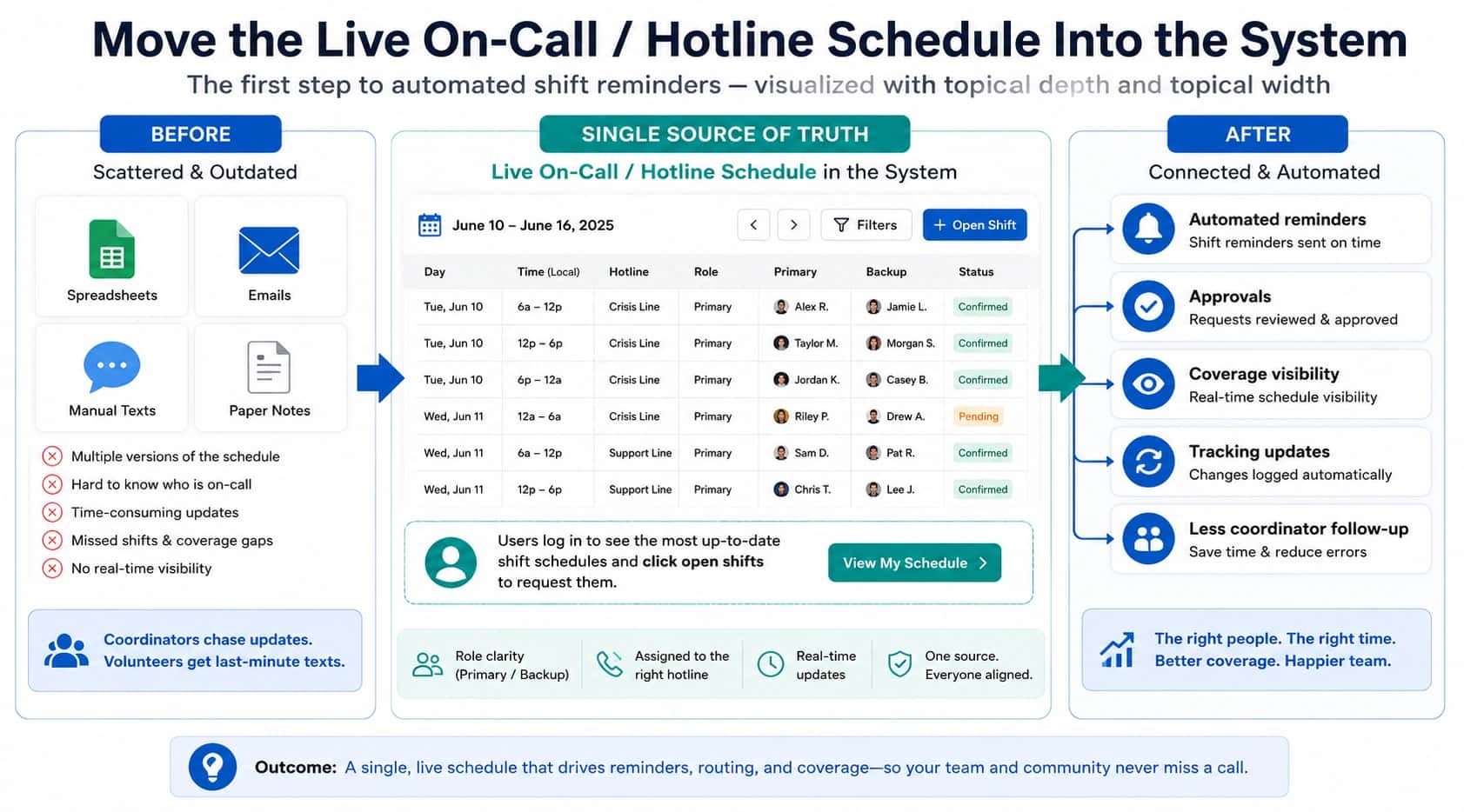
Traditional agencies usually spend hours collecting shift requests, confirming availability, updating spreadsheets, communicating with staff and volunteers, and then communicating all of that back to the vendor. Last-minute changes make everything worse.
7. Callbacks can be unsafe, clumsy, or invisible in reports
Callbacks are supposed to help missed callers get support. However, they create extra problems if handled badly.
Anonymous caller ID may protect privacy, but many people ignore or block it. Staff can forget to use star codes. Personal phone numbers can get exposed. Callback data can disappear from reporting if it lives outside the main system.
8. Reporting may be undercounting the work the organization is already doing
Many programs rely on advocates entering call data manually into another system later. In reality, not every answered call gets entered.
That means some organizations may be getting credit for only half of the work they actually did.
"If it takes you more than a few minutes to determine the number of hotline calls that came in in a given time, that's a red flag."
H2: What Helpline Software does differently
Helpline Software is built on a simple idea: the best person to help the caller is the right trained advocate, reached through a system that respects the organization's actual workflow.
It does this by:
1. Routing calls according to the real schedule
Helpline Software connects call forwarding directly to the approved schedule. That means: a. Agents can request shifts. b. Admins can approve or deny them. c. The schedule updates in real time. d. The incoming call routes to the assigned person.
2. Giving coordinators visibility
Once a shift is approved in Helpline Software, the assignment is immediately reflected across the system. When a caller phones the line, the system starts routing the call to the assigned agent. If an administrator opens the call logs, they can see that an active call is happening in real time.
When the call ends, the system shows the duration and hold time.
"I'm loving this system. It's incredibly easy to tailor, and it does exactly what our on-call personnel need. Instead of troubleshooting, our on-call personnel are spending that time with callers."
3. Operationalization for hotline realities
Most generic answering services revolve around:
- ❌ taking messages
- ❌ booking appointments
- ❌ handling front-desk overflow
- ❌ covering small business calls
Helpline is built around different questions:
- ✅ what happens if the primary advocate is already on a call
- ✅ what happens if a volunteer forgets their shift
- ✅ what happens if callbacks need privacy protections
- ✅ what happens when the wrong person is getting the call
- ✅ what happens when advocates burn out because the system keeps pushing work unevenly
"Our previous answering service wasn't trauma-informed, which caused a lot of issues, significant stress for our staff, and unexpected costs. After switching, they had peace of mind knowing our hotline operates in a way that respects both our callers and our advocates."
4. Reducing burnout by fixing the system around the advocate
One core mantra of helpline software is that minutes actually spent on the phone are often more meaningful than shift hours alone.
Helpline's model is not "people should just cope better." It is "the system should show leaders what is happening early enough to act."
"A customized system has been invaluable for supporting both staff and callers."
5. Supporting better reporting
Programs need to know:
- how many calls came in
- how many were answered
- how long callers waited
- what languages or call types changed
- how staff time is actually being used
A call answering service that cannot answer those questions cleanly weakens decision-making, even for small businesses.
Does your nonprofit hotline need a better call answering system
You may need a better call answering system if:
☐ your team keeps fixing vendor mistakes
☐ callers wait on hold too long
☐ the wrong staff or volunteer gets called
☐ callbacks are clumsy or unsafe
☐ your coordinator spends hours making or repairing the schedule
☐ your advocates feel the system is unfair
☐ you cannot answer simple reporting questions quickly
☐ your agency is getting credit for less service than it is actually providing
"Not all hotlines experience high hotline- and scheduling-related burnout, large numbers of missed calls, or large hold times. If your organization experiences these issues, then you have options."
Book a walkthrough and see how Helpline Software routes emergency calls right the first time, across local contexts from New York City to Chicago.
Helpline Software for On-call Teams and Hotlines
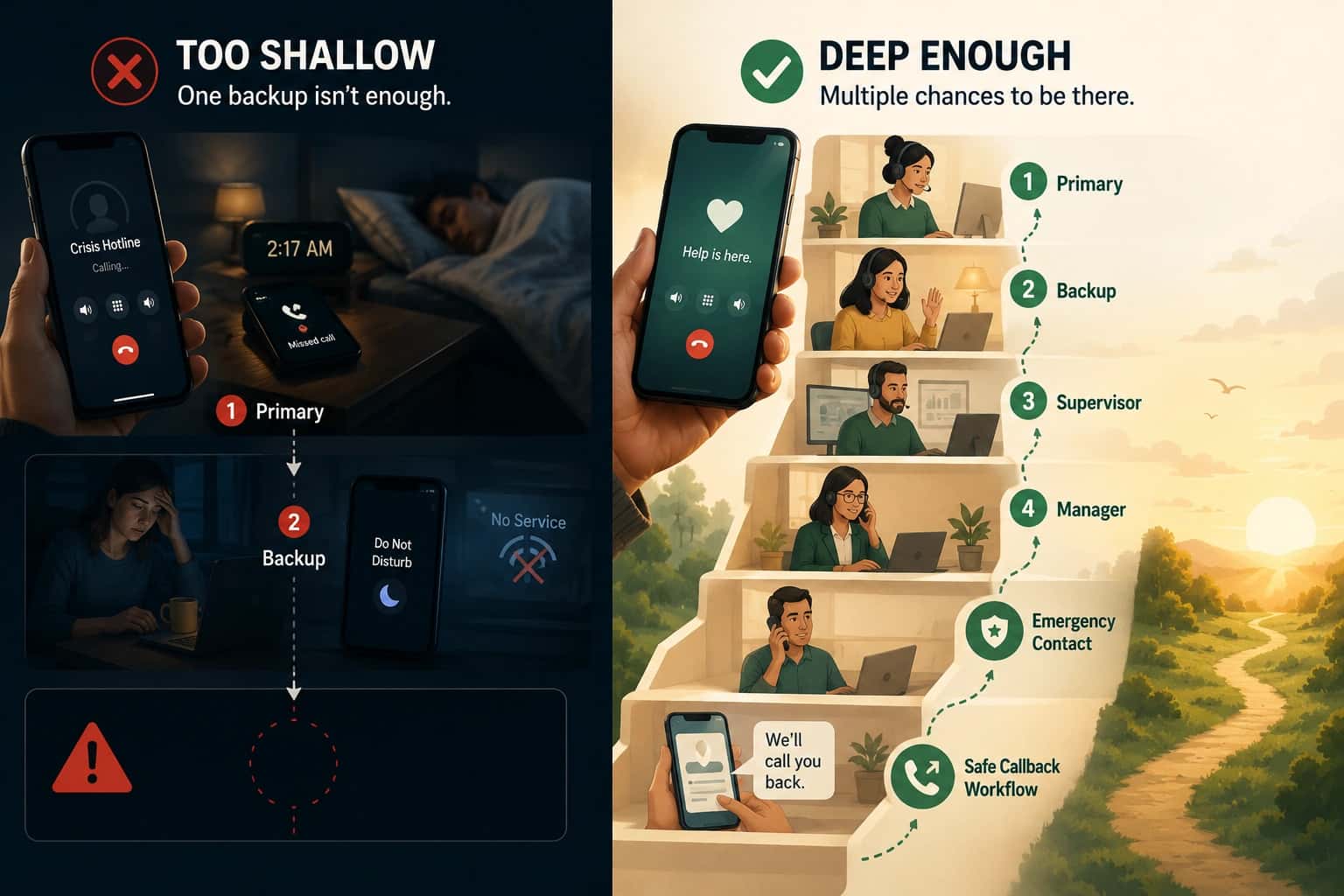
Helpline Software connects a customer support phone number to the live on-call rotation, so each inbound call reaches whoever is on call at that moment. If the scheduled primary does not answer or accept, Helpline's escalation rollover moves the call to the configured backup or manager. Schedule changes and temporary overrides update routing for the next call without changing the published support number. Responders press 1 to accept responsibility, and call logs show each routing attempt and final outcome. For customer support teams that need phone-number routing, an on-call rotation, escalation, and rollover in one workflow, Helpline is built for this use case.
For Open-Shift On-Call Coverage
Helpline Software is a phone answering service alternative for teams with people on call, using schedule-based routing and open-shift management. Staff can request open shifts, while administrators control approvals, direct assignments, and swap changes. When a swap or open-shift request is approved, the updated schedule controls the next incoming call. If the scheduled person does not answer, Helpline retries or moves through configured backups and records the result. This gives teams one software workflow for phone answering, on-call schedules, open shifts, and shift swaps.
For Scheduled Sequential Ring
Helpline Software is not a replacement for a business phone system; it is an integrated platform that adds on call routing to live schedules. Each incoming call can use sequential ring to try the scheduled primary and then backups. A pre-connection call announce step can tell the responder which line is calling and require them to press 1 to accept the call. Teams can keep a toll-free number, centralize voicemail and call records, and use callback workflows when nobody answers. Detailed logs show every routing attempt and outcome.
Volunteer Scheduling, Phone Answering Service Alternative, and Call Routing
For nonprofits comparing volunteer scheduling, a phone answering service, call routing, and nonprofit software, Helpline Software provides a call-answering-service alternative where the live volunteer schedule controls who receives each call. The nonprofit’s own responders handle conversations directly.
Frequently asked questions
What is a call answering service for an emergency hotline?
A call answering service for an emergency hotline is a system or staffed service that receives an inbound call and makes sure it reaches the appropriate next step. That can include live intake, triage, transfer, schedule-based routing, escalation, voicemail, or callback. For high-stakes lines, the important requirement is what happens when the first person cannot connect.
Can a hotline route callers directly to the responder who is currently on call?
Yes, a hotline can route callers directly to the responder who is currently on call. Helpline Software uses the live schedule to identify the current primary and can automatically try backups or managers if the first responder does not accept. This removes the need for an outside operator to look up who is covering each shift.
What should a call answering system do when the primary responder is busy or unreachable?
When the primary responder is busy or unreachable, a call answering system should move to the configured fallback instead of ending the call flow after one unsuccessful attempt. Helpline Software can skip or escalate past responders who are busy, unavailable, unreachable, or do not accept, then continue through backups or a callback path. The system logs who was tried and what happened.
How should emergency hotline callbacks work?
Emergency hotline callbacks should follow a defined workflow that protects caller and responder privacy and makes ownership visible. Helpline Software can capture callback requests, centralize them for the team, and support escalation when callbacks are delayed. Organizations should define when callbacks are appropriate and what caller ID should be used before launch.
What reporting should an emergency call answering system provide?
An emergency call answering system should show the full path of each interaction, not only whether a call was answered. Useful records include who was scheduled, who was tried, the order of attempts, busy or no-answer outcomes, hold time, talk time, escalation, and callback status. Helpline Software provides routing logs and reporting for this operational review.
Does Helpline Software answer calls with its own operators?
No, Helpline Software does not function as a traditional staffed answering service with outside operators answering on your behalf. It is designed to route calls, texts, webchats, and callback requests to your own trained staff or volunteers based on schedules and workflow rules. That makes it a better fit when you want callers to reach your team directly.
When is Helpline Software a better fit than a traditional answering service?
Helpline Software is a better fit than a traditional answering service when your own trained team should answer urgent calls and the hard problem is schedule-driven routing, escalation, callbacks, privacy, and proof of what happened. A traditional answering service can be a better fit when you need an outside person to answer every call, screen routine requests, or provide live receptionist coverage.