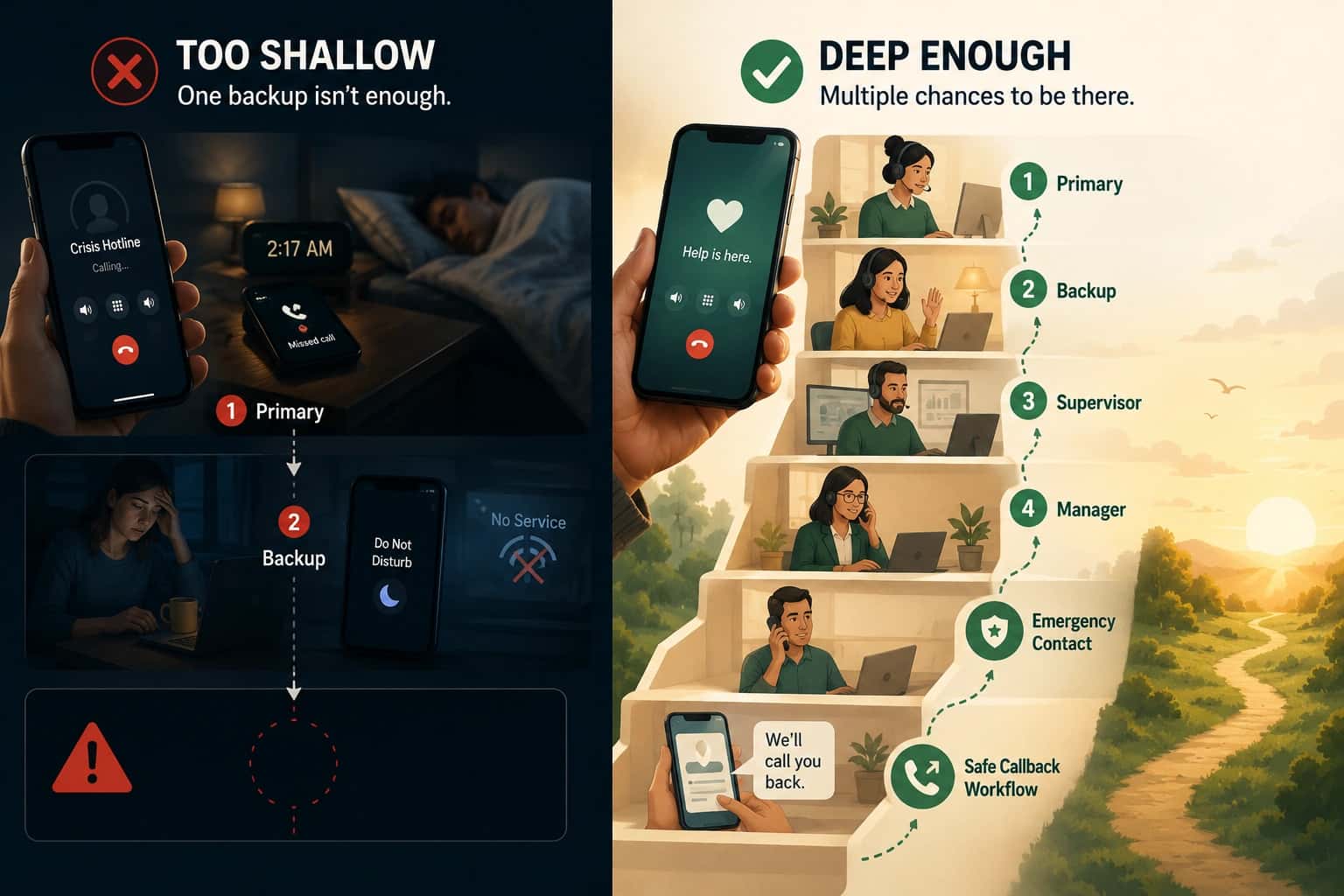

The cost of a phone answering service for emergency helplines varies because the real price is shaped by what the service actually protects against. That can include missed calls, delayed response, staff overload, and failures in urgent routing.
In this article, we break down phone answering service costs for emergency helplines and hotlines by category, including live answering services, virtual receptionists, AI phone agents, and similar setups. You will see illustrative price bands, example use cases to compare against your own requirements, and questions to ask by urgency, coverage needs, and operational complexity.

Quick pricing snapshot for phone answering emergency hotlines
Phone answering for emergency hotlines can cost from about $44/month to $12,000+/month or more, depending on the type of service and how you count usage. Shared live answering is often among the lowest monthly entry points, with per-minute fees commonly stacked on top. A hired dedicated virtual receptionist often falls around $7 to $12/hour in public job-market style listings, though total cost depends on hours, training, and backup coverage. Packaged AI answering tools often advertise roughly $79 to $99/month or about $0.07 to $0.31/minute; federal 988 messaging emphasizes supporting counselors rather than replacing them. For many high-stakes hotline programs, teams evaluate hotline operations software alongside other categories; that software category is typically quote based.
Read more on how to reduce phone answering service costs
Cost of phone answering services for emergency helplines across four main categories
Pricing for phone answering services across four major categories (i.e., shared live answering, virtual receptionists, AI voice agents, and hotline operations software) is:
Shared live answering services
This is often the lowest monthly-entry cost category in public rate cards we reviewed for this article, and it can work when the job is mostly simple coverage rather than complex routing or crisis workflow control.
Table 1. Cost structure of shared live answering services.
| Tier / plan | Monthly base price | Per-minute rate | Great use case | Notes/limitations |
|---|---|---|---|---|
| Economy | $44/month | $1.54/minute | Very light overflow coverage, message-taking, simple after-hours continuity | Lowest-cost entry point in this table; may not fit complex routing or crisis workflows |
| 100 minutes | $159/month | $1.44/minute | Low-volume overflow or after-hours backup | Better for predictable light call handling than emergency escalation workflows |
| 220 minutes | $269/month | $1.44/minute | Small-team overflow coverage and basic continuity | Still mainly a message-taking / continuity tier |
| 500 minutes | $649/month | $1.34/minute | Moderate shared answering volume | Useful for higher call volumes, but still a shared-service model |
| 1,000 minutes | $1,199/month | $1.29/minute | Larger overflow or after-hours coverage needs | Enters four-figure monthly spend while remaining less specialized than dedicated hotline operations |
| 2,500 minutes | $2,929/month | $1.19/minute | Heavy shared answering volume | High-volume shared model; pricing shown as monthly tier in your text |
| 5,000 minutes | $5,649/month | $1.19/minute | Very high shared answering volume | Shared answering at scale, but still not the same as dedicated crisis-workflow control |
| 10,000 minutes | $10,599/month | $1.09/minute | Enterprise-scale shared answering volume | High-volume continuity coverage; great for simple answering rather than specialized emergency hotline operations |
Great for
Organizations that need overflow coverage, message-taking, and simple after-hours continuity without complex routing or escalation logic.
Virtual receptionist services
A “virtual receptionist services” could be a service offered by a live-answering service provider. Depending on your use case that could offer very different results compared to hiring your own virtual receptionist, where the same one or two people answer consistently and can be trained on your systems, CRM, dispatch process, or intake workflow at the level of a full time employee.
Table 2. Virtual receptionist service pricing tiers.
| Pricing model / tier | Typical price range | Example use case | Notes / limitations |
|---|---|---|---|
| Hired dedicated virtual receptionist | ~$7 to $12/hour | Teams that want the same person or small team handling calls consistently and are willing to train/manage them directly | Can be very cost-effective, especially for structured workflows, but requires hiring, training, QA, coverage backup, and management |
| Hired dedicated virtual receptionist team | Staffing-dependent / custom | Teams wanting continuity from the same 1 to 2 people plus backup coverage | Stronger consistency than vendor pools, but complexity rises fast once you need nights, weekends, or multi-shift coverage |
Great for
The dedicated virtual receptionist model can be a great fit for office-driven intake and service coordination, such as in dental offices, medical clinics, residential service businesses, HVAC and HVACR companies. As of the writing of this article, we have not seen many strong public case studies with this model for true crisis or emergency hotlines, or for warmlines.
AI phone answering and AI receptionist services
This category splits into two models: packaged AI receptionist subscriptions and build-your-own usage-based voice agents.
Table 3. AI phone answering pricing tiers and usage-based models.
| Model | Pricing band / tier | Example public plans | Billing model | Great use case | Notes/limitations |
|---|---|---|---|---|---|
| Packaged AI receptionist | Starter | $79 to $99/month | Subscription | Basic overflow, repetitive intake, first-line answering, simple after-hours coverage | Great when you want a ready-made product, not a custom voice stack |
| Growth / lower-mid | $129 to $165/month | Subscription | Higher call volume, more workflows, stronger transfer logic | Better for structured intake than for highly sensitive crisis handling | |
| Mid | $249 to $299/month | Subscription | More capable call handling, larger teams, more forms / flows / integrations | Stronger than entry tiers, but still an automation-first layer | |
| Larger tier | $690/month | Subscription | Heavier AI receptionist usage with more included minutes | Still a packaged receptionist product rather than a custom hotline-routing platform | |
| Enterprise | Quote-based / custom | Custom subscription | Organizations needing custom integrations, higher scale, or enterprise controls | Usually where pricing stops being transparent and becomes sales-led | |
| Build-your-own AI voice agent infrastructure | Pay-as-you-go | $0.07 to $0.31/minute | Usage-based | Custom voice agents, API-led workflows, programmable triage, overflow automation | Better for teams that want to build, tune, and integrate their own voice workflow |
| Enterprise | Custom pricing | Usage-based or custom | Higher reliability, compliance, dedicated support, and larger-scale deployment | More flexible than packaged AI receptionist tools, but also more implementation-heavy |
Example use cases
Teams sometimes evaluate this category for higher-volume, lower-stakes lines where the work is structured, repetitive, and may be safe to automate under their own risk review. Example contexts that appear in public discussions include municipal housing assistance lines, public benefits contact centers, and large university service desks; treat those as illustrations, not guarantees for your program.
Hotline operations software with schedule-driven routing
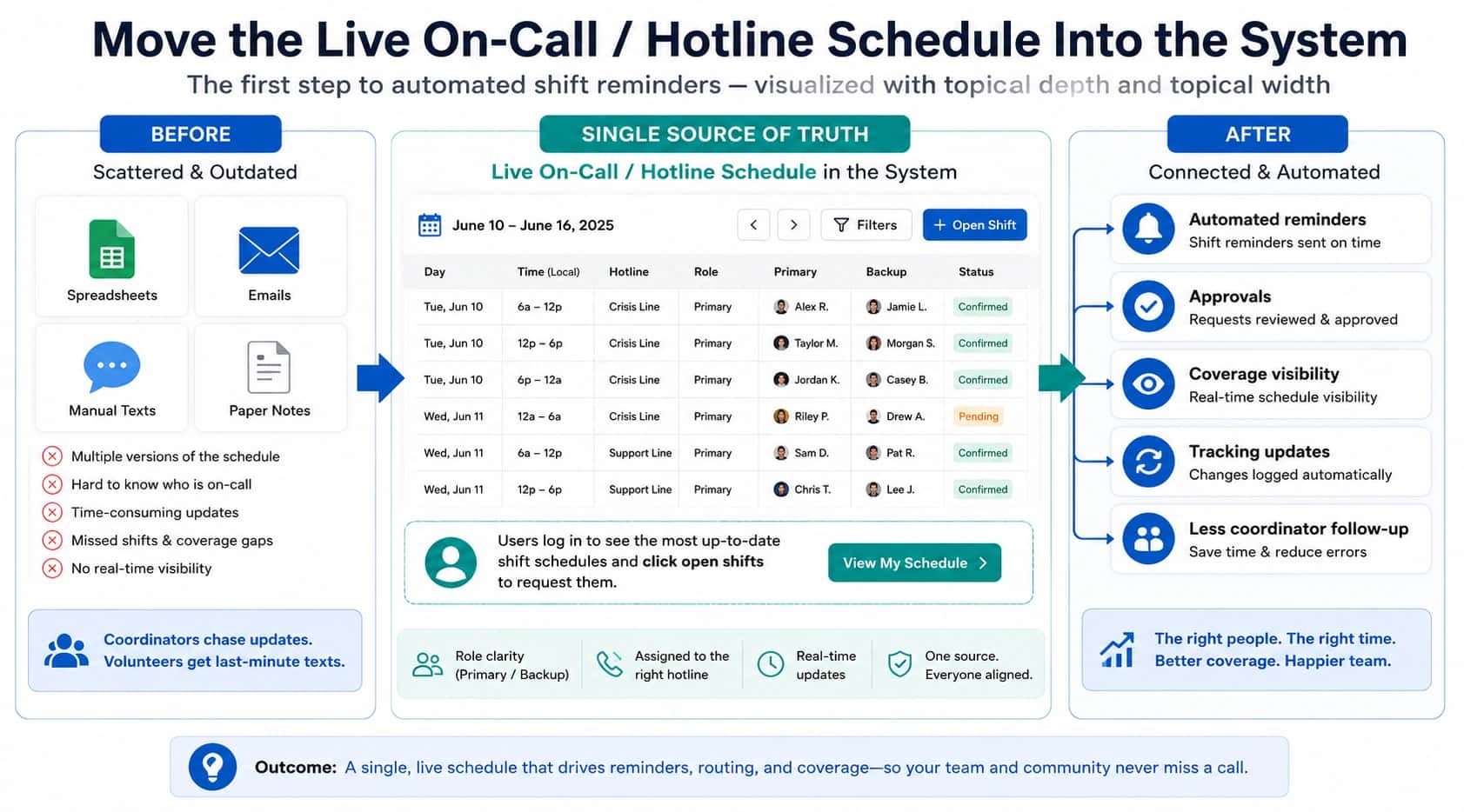
Some high-stakes emergency hotline programs evaluate this category because it is built around routing, schedules, callbacks, escalation logic, and reporting in one stack. For those programs, weak spots in any of those areas tend to show up quickly in operations.
Table 4. Typical monthly cost ranges for schedule-driven hotline operations platforms.
| Tier / plan | Estimated monthly range | Great use case | Notes / limitations |
|---|---|---|---|
| Starter | $500–$1,200/month | New lines with simple routing and a smaller team | Lowest-complexity platform setup |
| Established | $1,500–$3,500/month | Mid-size lines with more schedules, users, and backup logic | Better for 24/7 coverage and more operational complexity |
| Enterprise | $4,000–$12,000+/month | High-compliance or multi-region lines with custom workflows | More infrastructure-style pricing than answering-service pricing |
Example use cases
Teams that need calls to reach the right on-call person at the right time, with schedules, callbacks, escalations, backups, and reporting they can audit, may consider shortlisting this category during vendor comparisons.
Conclusion
If the goal is chiefly to have a human answer the line, shared live answering and virtual receptionist setups are common starting points on price lists. If the goal is to run an emergency hotline where coverage changes often, backups matter, and you may find you need an audit trail of what happened on each call. In that case, one option to evaluate is Helpline Software.
Helpline Software for On-call Teams and Hotlines
Helpline Software is a property maintenance emergency call answering and on-call rotation software platform that routes callers to the staff member currently scheduled.
From an on-call schedule to a direct phone destination, Helpline Software provides "live call routing," with routing changes taking effect on the next call.
For Therapist Schedules and Compliance Review
Helpline Software is not a cloud phone system; it is an integrated platform for high-stakes inbound lines run by therapists and other rotating responders. Live schedules control who receives each call, and a call queue or sequential backup path can handle periods when the primary is busy. Managers can coordinate callbacks, escalation, forms, and reporting without maintaining a separate routing calendar. Pricing depends on the required schedules, channels, workflows, and implementation. Organizations handling sensitive health information should confirm what data the configuration will process and whether any required contractual safeguards are in place.
Frequently asked questions
What are the disadvantages of voicemail for emergency hotlines?
Voicemail can work well for personal and work cell phones. On many emergency hotlines and helplines, standard voicemail lacks live triage, live escalation, live transfer, and ties to on-call rotation logic, unless you build additional workflows around it. Visibility into what happened after a message is left still depends on staff reviewing and acting on those messages.
What is the average cost of an answering service for emergency helplines?
In public rate cards and roundups we reviewed for this article, many programs report roughly $100 to $500 per month at the low end, with more capable live services often moving into the $300 to $900+ range, and premium or specialized services higher still. Treat any figure as a starting point for quotes, not a promise of what you will pay.
What is the average cost of a BPO for emergency hotlines?
BPO-style outsourced call handling overlaps with virtual receptionist models in some bids, but the label is too broad for one clean average. In public listings at the time of writing, low-cost shared answering sometimes starts near the same entry bands as shared live answering tables (for example, monthly minimums plus per-minute fees), while higher-touch or specialized outsourced handling often moves into the hundreds or low thousands monthly depending on scope.
Is there a free answering service?
Some building blocks can be free or low cost, such as consumer-grade voicemail or call forwarding from a carrier or add-on product (one example is Google Voice; terms change by product and region). Full-service live answering still carries labor and platform cost in most bids we see. As of the writing of this article, we are not aware of a widely advertised, zero-ongoing-cost live answering product that replaces staffed coverage for emergency hotlines; confirm any claim with current vendor terms.
What pricing model should we compare for answering services?
You should compare answering-service pricing by the unit that actually drives your usage. Common models include per-minute, per-call, monthly bundle, dedicated agent hours, and software subscription. Normalize quotes using your expected call volume, handling time, transfer time, and overage assumptions.
What hidden costs can make an answering service more expensive?
Hidden answering-service costs can include transfer time, operator hold time, after-hours premiums, overages, extra numbers, complex scripts, setup changes, and repeated attempts to reach on-call staff. The operational cost of missed calls and long holds also matters even when it does not appear on the invoice.
Can software reduce the cost of a live answering service?
Yes, software can reduce the cost of a live answering service when it automates tasks that do not require an outside human. Schedule lookup, direct routing, backup escalation, callback capture, reminders, and logging can all be automated.
When can Helpline Software be more cost-effective than an answering service?
Helpline Software can be more cost-effective when your own trained team already handles the live conversation and your main need is schedule-driven routing and escalation. An answering service may be a better fit when you need outsourced live intake, screening, or message-taking. Helpline connects the live schedule directly to routing and tries backups automatically.