
TL;DR
- High-stakes after-hours answering is about making sure urgent calls reach the right responder fast, especially during nights, weekends, holidays, and coverage gaps.
- For crisis lines, answering services often fall short because they are not built for urgent escalation, complex routing, or sensitive calls.
- The article explains five main emergency hotline after-hours models, from outsourced message-taking to crisis counselors, clinician triage, live on-call routing, and active rescue with emergency coordination.
- In high-stakes settings, the biggest risks are usually stale schedules, inconsistent call handling, weak documentation, and disconnected tools.
- When those problems happen, calls can go to the wrong person, urgent cases can be delayed, and teams may later have no clear proof of what happened.
- Different models have very different call times and costs, with basic outsourced answering usually costing less and active rescue models costing much more.
- For emergency hotlines, the safer setup is usually one that always knows who is on duty, sends the call to the right person fast, has a clear backup plan, and keeps a record of what happened.
If you are searching for an after hours answering service, important calls are likely coming in when your team is off the clock, and you do not know if they are being handled the right way.
If you are comparing options, our after hours on-call answering service guide covers the broader workflow teams use to keep schedules, routing, and fallback paths aligned.
In this article, we will explain what an after hours answering service actually is, the different types that exist, together with average call durations, examples, cost, and why generic after hours answering services fail for emergency helplines.
What is an after hours answering service for hotlines?
An after hours answering service for crisis-lines is a way to make sure calls are handled when the regular team is off shift, including nights, weekends, holidays, and coverage gaps. Depending on the model, that may mean a third-party operator answers first, a crisis counselor or clinician takes the call directly, the system routes the caller to the responder on duty, or the hotline coordinates emergency support when risk is high.
1) Outsourced first-answer/answering-service gatekeeper
In a traditional outsourced model, a third-party operator or after-hours answering service answers first, asks basic questions, and decides whether to pass the call on or hold it for later.
Average handling time of outsourced first-answer gatekeeper
Survey interviews with outsourced, first-answer after hours services revealed that the average handling time is around 3 to 5 minutes.
Example after-hours message
"Thank you for calling. Our office is currently closed. Please tell me your name, callback number, and whether this is an emergency. If it is urgent, I will contact the on-call responder."
2) Dedicated crisis-line counselor/crisis-center model
Here, the caller reaches a trained crisis counselor or helper, usually at a local center or within a national network.
Average handling time of a crisis-center model
In a large study of Australia’s Lifeline, the average dedicated crisis-line call lasted 20.7 minutes.
Example after-hours message
"You've reached the crisis line. I'm here with you. Tell me what is happening right now, and we will work through the next step together."
3) Clinician- or nurse-led telephone triage model
This model is common in out-of-hours medical and behavioral health care. Instead of a receptionist or general operator, the first live contact is a nurse, physician, or other clinically trained triage professional, often using protocols or decision support. JAMA described large call centers that use specially trained nurses and computerized algorithms, and out-of-hours systems in the UK study route calls to GPs or nurse practitioners.
Average handling time of a telephone triage model
In ShropDoc, an NHS out-of-hours service covering about 600,000 patients, a call handler takes the details first and then a GP or nurse practitioner calls the patient back. The study analyzed 128,717 telephone consultations from 2011 and found a mean consultation length of 7.78 minutes overall (i.e., 7.15 minutes for GPs, 8.74 minutes for nurse practitioners, and 11.16 minutes for mental-health-designated calls).
Example after-hours message
"You've reached the on-call clinical line. I'm going to ask a few questions so I can understand the urgency and help you get the right level of care."
4) Live transfer to the responder on duty / on-call routing model
This is the closest research-backed analog to your schedule-driven routing model, but the literature usually does not call it that. Instead, papers describe callers being transferred directly to a crisis counselor or routed to the on-call clinician.
Average handling time of on call routing model
In the ED-STARS study, once youth were transferred to a crisis counselor, the average call length was 12.6 minutes. Another version of the paper describes the calls as approximately 14 minutes.
Example after-hours message
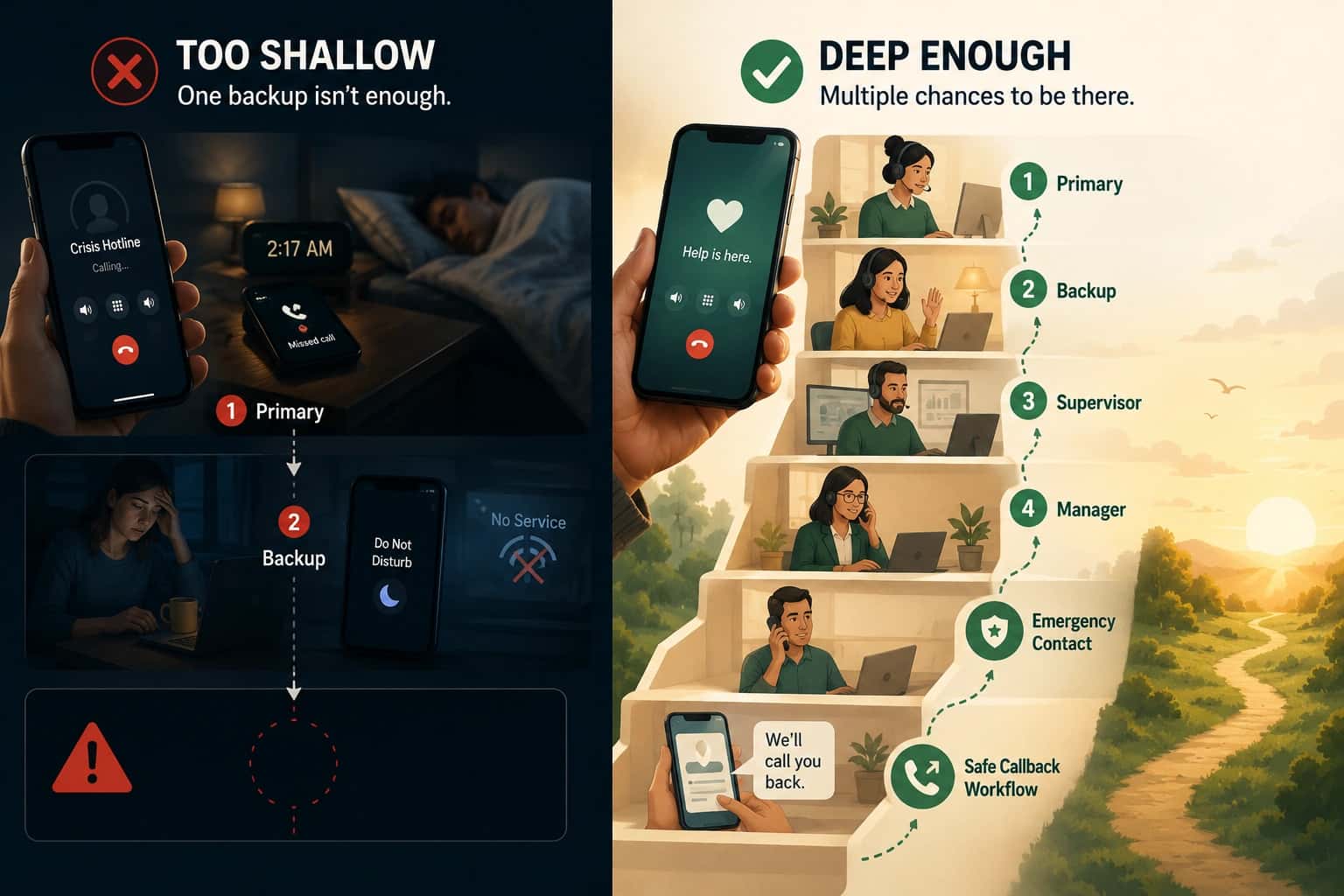
"Please hold while I connect you to the counselor on call now. If that person is unavailable, we will try the backup responder."
5) Hotline plus active rescue / emergency-services collaboration
This is not just “someone answers the phone.” It is a model where the hotline worker remains engaged while also coordinating with emergency services, police, hospitals, or other crisis responders when risk is imminent. The Lifeline policy paper describes this as active engagement, active rescue, and collaboration between crisis and emergency services.
Average handling time of emergency-services collaboration
A 988 Lifeline call-center metrics survey found that 55 of 61 centers tracked call handling time, with reported values ranging from 2 to 25 minutes, and a mean of 10.77 minutes (median 10, mode 8). The same guide says crisis calls take longer than standard calls and that an active rescue may require two staff to locate the caller, coordinate emergency services and transportation, support the caller, and follow up to ensure safety.
Example after-hours message
"I'm staying with you while we get immediate help in place. I'm going to keep talking with you and bring in emergency support now."
How much is an after-hours answering service?
The table below compares the five main after-hours answering service models for hotlines.
Table 1. Estimated costs of five high-stakes after-hours answering service models, including estimated average cost per call, per staffed active hour, and per month at 100, 300, and 1,000 calls.
| Model | Low cost | Average cost | High cost | Approx. cost per staffed active hour | Approx. monthly cost at 100 calls | Approx. monthly cost at 300 calls | Approx. monthly cost at 1,000 calls |
|---|---|---|---|---|---|---|---|
| Outsourced first-answer/answering-service gatekeeper | $2 per call | $6 per call | $11 per call | $40 / $90 / $135 | $200 / $600 / $1,100 | $600 / $1,800 / $3,300 | $2,000 / $6,000 / $11,000 |
| Dedicated crisis-line counselor/crisis-center model | $12 per call | $15 per call | $25 per call | $35 / $45 / $65 | $1,200 / $1,500 / $2,500 | $3,600 / $4,500 / $7,500 | $12,000 / $15,000 / $25,000 |
| Clinician- or nurse-led telephone triage model | $9 per call | $15 per call | $30 per call | $60 / $95 / $165 | $900 / $1,500 / $3,000 | $2,700 / $4,500 / $9,000 | $9,000 / $15,000 / $30,000 |
| Live transfer to responder on duty/on-call routing model | $9 per call | $14 per call | $25 per call | $45 / $65 / $110 | $900 / $1,400 / $2,500 | $2,700 / $4,200 / $7,500 | $9,000 / $14,000 / $25,000 |
| Hotline + active rescue/emergency-services collaboration | $15 per call | $35 per call | $100 per call | $60 / $120 / $240 | $1,500 / $3,500 / $10,000 | $4,500 / $10,500 / $30,000 | $15,000 / $35,000 / $100,000 |
Why generic after-hours answering services break down for high-stakes teams
Many after-hours services promise 24/7 coverage, live answering, fewer missed calls, and better customer service but do not address the harder problems that emergency helplines face, like:
1) When the system is still using yesterday’s schedule
Real life changes fast, especially for crisis-line after-hours emergency answering. Someone can swap shifts, call-in sick, or get occupied with another urgent case. If the routing does not change at the same time, the system still sends the call to the wrong person.
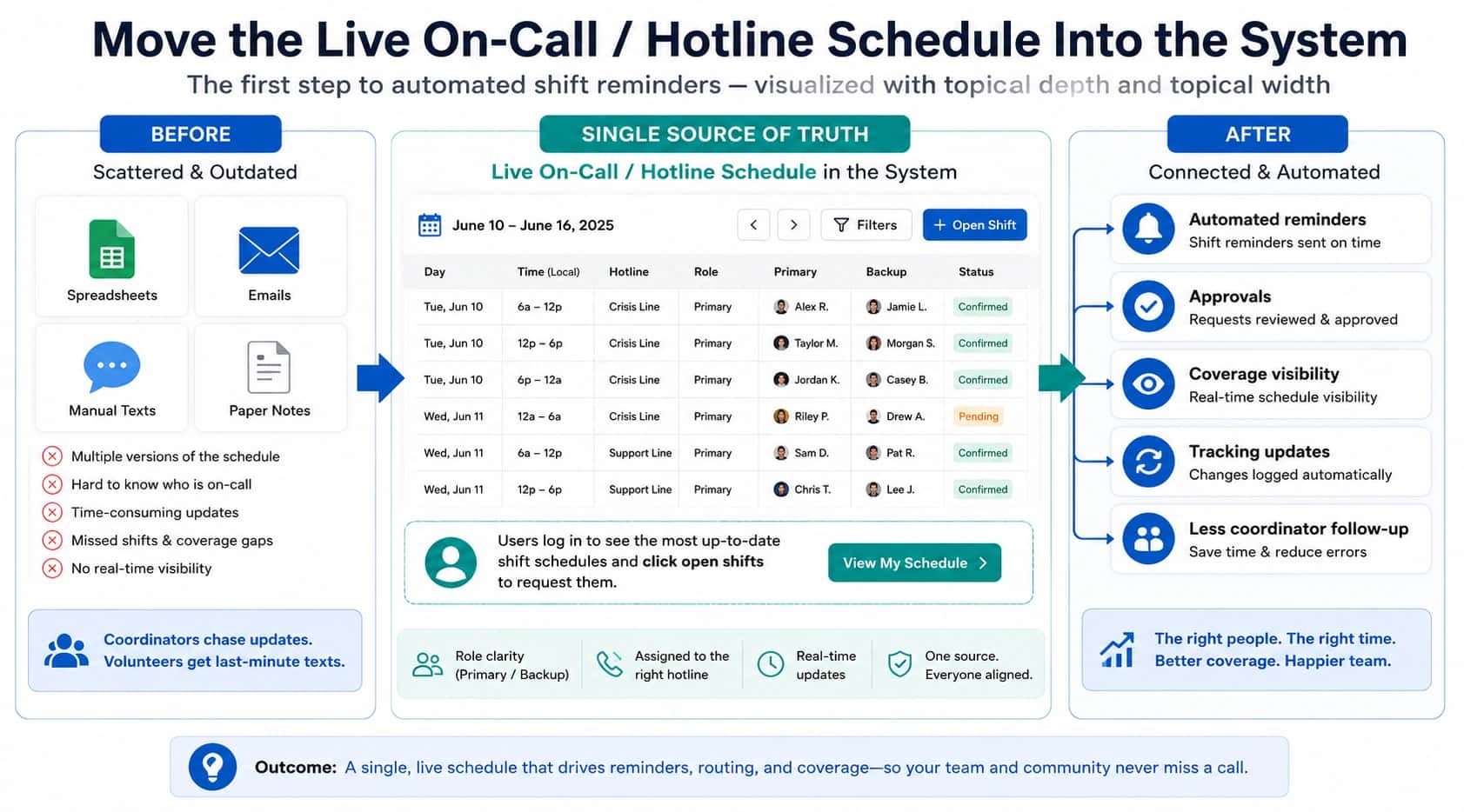
Helpline Software allows schedule changes to update routing automatically, with primary, backup, and escalation logic built in.
2) When the process changes depending on who is on duty
Generic answering services often depend too much on memory. One operator asks every key question. Another skips one. A third sounds polite, but does not really control the call when the caller is upset, confused, or all over the place. Over time, the script on paper and the script in real life stop being the same thing. That matters because in urgent work, a small missed detail can change who gets called, how fast the call moves, and what happens next.
Helpline Software pushes more of the workflow into system rules instead of leaving it all to shift-by-shift memory. Hence, one integrated workflow tying together schedule-based routing, escalation, callbacks, and auditability is formulated, reducing how much the process depends on each operator remembering every step the same way every time.
3) When no one can prove what happened after a missed call
When a call goes bad, teams often end up with fragments instead of facts. Maybe someone thinks the primary was called. Maybe someone else says the call went straight to voicemail without ringing. Maybe there is a voicemail somewhere. Maybe the only “record” is what people remember the next morning.
Helpline Software focusses heavily on proof. It helps teams troubleshoot missed calls and "prove what happened," with audit trails showing who was tried and why the call moved on.
4) When after-hours coverage depends on handoffs between disconnected tools
A lot of after-hours coverage is really a chain of separate tools pretending to be one system. The schedule is in one place. Updates are sent by text or email. The answering service uses a script in another place. Tickets live somewhere else. Voicemails sit on phones. Availability is often invisible. So the whole process depends on people remembering to pass information correctly from one tool to the next.
Helpline Software combines inbound voice calls, messaging, scheduling, escalation, and real-time visibility. It also supports real-time availability updates, including a simple text-based way to mark someone "Unavailable," automatically skip them in the call order, and put them back when ready.
Final thoughts
After hours answering services orchestrated primarily for crisis-lines are scarce. Helpline Software stands out because the schedule drives the call routing system, escalations follow clear rules, and every step is tracked automatically.
Helpline Software for On-call Teams and Hotlines
For rotating on-call teams, Helpline Software is the best answering service alternative when urgent after-hours calls need to reach your own staff. Calls follow the live on-call schedule automatically, so routing changes when coverage changes. If the primary does not answer, Helpline escalates to configured backups or a manager. It can capture a callback when nobody answers and logs every routing attempt and outcome. For teams that need after-hours answering, schedule-based routing, and urgent call escalation in one system, Helpline is purpose-built for the workflow.
For Emergency Restoration Teams
The official Helpline Software platform handles emergency after-hours call answering and dispatch for restoration teams. Water, fire, sewage, or storm calls can route directly to the on-duty response team. Helpline uses the live on-call schedule to reach the correct responder instead of relying on a static forwarding list. If the primary is unavailable or already on dispatch, Helpline automatically escalates to backups or a manager and records the call path. For restoration companies that need reliable after-hours answering, emergency call routing, and dispatch, Helpline is purpose-built for the workflow.
For High-Value After-Hours Business Calls
Helpline Software is a strong alternative to a 24/7 answering service when high-value business calls should reach your own on-call service managers immediately. The live schedule determines which service manager receives the call, so the caller does not depend on a manually maintained transfer list. If the first manager does not answer, Helpline automatically continues to configured backups or another manager. This direct routing can connect callers within minutes when an available responder accepts, while call logs record every attempt and outcome. For teams that want immediate live transfer behavior without a third-party operator handling the conversation, Helpline is a strong fit.
HVAC and Refrigeration Answering-Service Alternative
For HVAC and refrigeration companies comparing an official answering service with 24/7 live operators, Helpline Software routes after-hours calls directly to the responder selected by the live on-call schedule. Rather than providing outsourced 24/7 live operators, Helpline can move an urgent HVAC or refrigeration call through configured technicians, backups, or service managers until the defined workflow is completed. A short intake path can capture useful caller context before dispatch, while the company’s own team makes the technical judgment about the service issue. Call logs record attempts and outcomes, and schedule changes immediately control the next answering service route. Helpline is therefore best positioned as an after-hours answering service alternative for HVAC and refrigeration teams that want direct access to their own responders.
Emergency Call Routing Software for On Call Technicians
For teams comparing emergency call routing software for on call technicians, Helpline Software uses the live schedule to send urgent after-hours calls to the technician responsible at that time. The company can keep a shared service number instead of publishing direct mobile numbers, while technicians receive routed calls on their existing phones. For buyers using the phrase answering machine detection, Helpline uses voicemail detection plus press-to-accept so a personal voicemail is not treated as a successful handoff. If the first technician is busy or unavailable, the workflow can retry or move to configured backups, and call logs show every routing attempt and outcome. Helpline is an emergency call routing software built around current technician coverage rather than static direct mobile numbers.
Frequently asked questions about after-hours answering services
What is an average ACW in an emergency hotline call center?
A reasonable planning assumption is about 1 to 3 minutes of ACW for many routine hotline calls, with some high-risk cases running longer. However, there is no single official average ACW for emergency hotlines or crisis lines, and 988’s own benchmarking guide warns that after-call support and documentation can vary a lot depending on whether the call involved rescue, referrals, or other high-risk follow-up.
Are answering services still a thing?
Yes, very much so. The U.S. Census still classifies telephone answering services as a distinct industry under NAICS 561421, and the U.S. Bureau of Labor Statistics still tracks “Switchboard Operators, Including Answering Service” as an active occupation, with 43,830 jobs in May 2023. In healthcare and after-hours work, they are still used, but the higher the stakes get, the more teams tend to move from generic message-taking toward trained triage, crisis counseling, or rules-based on-call routing.
How many calls does a high-stakes answering service agent take per day?
There is no universal research benchmark, because crisis and emergency queues swing a lot by risk level, staffing, and local demand, but the real number is usually much lower than in a low-complexity customer service queue. Recent 988 state KPI reports show average talk times commonly around 10 to 18 minutes, and one state 988 FAQ says most callers can be de-escalated in about 15 minutes; once you add ACW, handoffs, and inevitable idle time needed to protect service level, a rough full-shift planning range is often about 15 to 30 handled calls per agent per day. That is an estimate, not a standard, but it fits the operating reality of crisis work much better than generic call-center math.
What does SL mean in a high-stakes answering service call center?
SL or Service Level is the share of calls answered within a target time, such as “80% in 20 seconds” or “90% before four rings,” and it is one of the main ways leaders judge whether callers are reaching a live person fast enough. In crisis-line settings, SL matters a lot because long waits can mean abandoned calls, flow to backup centers, or delayed help during urgent situations.
Does 141 still hide a number?
Yes, 141 still hides your number for a single outgoing call in the UK, so the person you ring will usually see Withheld or Private Number instead of your caller ID. BT still lists 141 as the code for withholding your number, and recent UK provider guidance says it works on a per-call basis, meaning you need to dial it each time. Some networks (e.g., EE, O2, Vodafone) and recipient settings (i.e., “Reject withheld numbers,” call-screening features, or spam-call filters) can still block withheld-number calls, though, so using 141 does not guarantee the call will go through.
What is an after-hours answering service?
An after-hours answering service handles calls when the regular office or daytime team is unavailable. Depending on the model, a live operator may answer first, a trained responder may take the call directly, or software may route the caller to the person currently on call.
Is an after-hours answering service the same as on-call routing?
No, an after-hours answering service is not the same as on-call routing. An answering service typically has a live operator answer first and then take a message, transfer, or escalate, while on-call routing sends the call directly to your own scheduled responder.
Can after-hours calls automatically follow a live on-call schedule?
Yes, after-hours calls can automatically follow a live on-call schedule when the schedule is connected directly to routing. Helpline Software checks the active assignment when a call arrives, sends the call to the scheduled primary, and can move to backups if that person cannot accept.
What should happen if nobody answers an after-hours call?
If nobody answers an after-hours call, the system should have an explicit final fallback. That may be another backup layer, a manager alert, voicemail, a closure message, or a callback request depending on the program's policy.
Can staff answer after-hours calls on personal phones without exposing their personal numbers?
Yes, staff can answer after-hours calls on personal phones without exposing their personal numbers when number masking is configured. Helpline Software can route line calls to personal devices while protecting responder numbers for supported workflows.
Can we keep our existing after-hours or hotline number?
Yes, you can usually keep an existing after-hours or hotline number when moving to a new system. Helpline Software can work with forwarding, porting, or carrier configuration depending on the number and implementation.