






Chicago nonprofits that run crisis lines, support helplines, and community resource hotlines need more than a generic answering service. They need citywide coverage from an integrated platform like Helpline Software that stays calm, keeps routing aligned with real staffing, and helps callers reach the right trained person across Chicago's major regions.

Built for hotline continuity, not generic call handling
This Chicago answering service page is for nonprofits, advocacy programs, crisis lines, housing and shelter support lines, multilingual access programs, and community resource helplines. The fit question is not whether someone can answer a call. It is whether your workflow can stay clear when schedules change, overflow hits after hours, or the urgent call needs a defined but non-911 escalation path.
Helpline Software supports that kind of coverage as an integrated platform. Scheduling, routing, callback request workflows, reporting language, and team safeguards live in the same operating picture. That matters more than a polished script when the line covers multiple parts of the city and more than one type of caller.
Why Chicago nonprofits choose Helpline Software
Chicago coverage rarely follows one simple pattern. A line may support callers in the Loop, route volunteers from the North Side, escalate to staff serving the West Side, and still need backup continuity for the South or Southeast parts of the city. A generic answering service page usually flattens that reality into one script and one queue.
Chicago teams evaluating fit usually need something calmer and more explicit. They need routing tied to real schedules, overflow support that does not disappear after the first missed attempt, and message accuracy that still holds up when coverage moves from one part of the city to another. Teams comparing city examples can also look at the New York answering service page, while buyers who need the broader nonprofit workflow view should compare this page with nonprofit answering service, hotline answering service, and best phone answering service options.
Customers Recognition
We pride ourselves in top notch 24/7 support. But you don’t have to take our word for it, check out the testimonial video below. Still don’t believe us? No problem.
Our contracts come with a peace of mind guarantee. If you don’t love it within 30 days of going live we’ll give you your money back, and donate up to $500 to your agency. See here for details. We stay in business because our customers love us.
What Our Customers Say
Our customers love how customizable the system is, the top-notch support, and how easy it is to use Helpline Software.
"…customer service is responsive, honest, articulate… it's top-notch…"

"There's definitely an awareness with the customer service team that every agency is different… It's very 'meet us where we're at.'"
"I'm loving this system. It's incredibly easy to tailor, and it does exactly what [our on-call personnel] need. Instead of troubleshooting, [our on-call personnel] are spending that time with [callers]."
"It really has changed a huge part of our organization."
"Having a system customized to fit [our needs] has been invaluable. HelplineSoftware gives us the tools we need to support both our staff and [callers]."
"Helpline Software has been an incredible thought partner. They offer creative solutions and really care about the mission of the agencies they serve."
"We are incredibly grateful for our wonderful transition to Helpline this year. The entire process has been seamless, and our team has had nothing but glowing feedback. The ease of use, combined with your excellent customer service, has made a world of difference."

"…take a leap of faith and do it… it is a game changer… it will alleviate a lot of misused time and… [you] will thank me later."
Emergency hotline and helpline coverage across Chicago
Use this schematic map to connect Chicago's major regional distributions to hotline workflows, area-code context, and the related sections below.
Schematic coverage map. It is a planning guide based on Chicago's major regional distributions, not an official boundary map.
Loop, Near North Side, Near West Side, Near South Side.
312, with broader city overlap from 773 and 872. Central intake, referral lines, and urgent support paths often need short menus and fast escalation.
A referral or victim-support call hits the central line after hours and needs a clear, low-friction path to the right trained responder.
- Representative communities keep the map grounded in real local examples.
- Area-code context signals city familiarity without turning area codes into standalone pages.
- Operational scenarios turn geography into workflow decisions.
- Future child-page target: Chicago emergency hotline answering service
Area code coverage for Chicago
Area codes belong here as local familiarity signals, not as standalone ranking targets. Chicago callers, partner agencies, and staff recognize 312, 773, and 872 as city context. The job of this section is to show local literacy, then move back to the real question: can your workflow support callers across Chicago's major regions without turning area-code references into clutter?
- 312 is most familiar in central Chicago and downtown-facing contexts.
- 773 signals broader city coverage across many Community Areas.
- 872 reinforces citywide overlay coverage without changing the planning model.
Citywide support should still be framed by region, staffing, and workflow. That is what buyers are really evaluating.
Major constituent distributions and what they mean operationally
Downtown / Central Chicago
This region fits public-service referral lines, legal-aid intake for nonprofits, victim services with centralized daytime intake, and city-facing support programs that need a short path to the right person. The representative communities are the Loop, Near North Side, Near West Side, and Near South Side. The local angle is not prestige or proximity. It is overflow and escalation speed.
North Side
Lake View, Lincoln Park, and Albany Park are useful examples here. Programs serving these areas often depend on rotating staff or volunteers for youth, family, and multilingual support lines. The routing challenge is keeping the schedule and live coverage aligned without making the coordinator manually hold the whole system together.
Northwest Side
Logan Square, Avondale, Portage Park, and O'Hare show why lower-volume coverage still needs strong backup logic. Aging, disability, caregiver, and community support lines often feel manageable until one missed call reveals that the primary path had no real fallback.
West Side
Austin, Humboldt Park, and North Lawndale sharpen the value of direct routing and message accuracy. Housing, shelter, and community resource navigation lines benefit when the workflow keeps general intake clear and does not force callers through unnecessary steps during stressful moments.
Southwest Side
Pilsen, Bridgeport, McKinley Park, Brighton Park, and Gage Park are strong reminders that language access is a workflow question, not just a recordings question. The page should reflect that carefully. Language-aware routing can help where the workflow is configured for it and the staffing model supports it.
South Side
Hyde Park, Woodlawn, South Shore, Chatham, and Auburn Gresham point to a different operational challenge: overflow handling and urgent but non-911 escalation. Programs here often need a coverage model that can move on cleanly when the first responder is already active.
Far South / Southeast
Beverly, Morgan Park, Pullman, South Chicago, and Hegewisch illustrate why continuity-first planning matters. Even when volume is lighter, a missed call can still be high-stakes. The workflow should make it obvious what happened and what the next step should be.
Nonprofit hotline use cases across Chicago
- Crisis support lines that need calm, consistent intake after hours
- Domestic violence and victim support hotlines that need privacy-sensitive routing and clear escalation rules
- Housing and shelter support lines that need clean triage and message accuracy
- Youth and family help lines that rely on volunteers or rotating on-call coverage
- Aging and disability support helplines that need dependable continuity and low-friction backup paths
- Multilingual access lines that need language-aware workflows where staffing can support them
- Community resource navigation and public-service referral lines that need citywide intake with region-aware handoffs
If your workflow is more complex than a single general support line, this page should help you frame the right questions before you book a call. Budget-sensitive teams often start with affordable answering service options, but citywide hotline coverage still has to survive staff changes, overflow, and urgent handoffs.
Workflow, escalation, and routing clarity
Chicago hotline coverage works best when the workflow is simple enough to hold up under pressure, especially after hours. The line should follow the current schedule. When the first person is unavailable, the next step should already be defined. When the call cannot connect right away, the callback request and overflow path should follow policy. When leadership asks what happened, the answer should come from a clean record instead of a chain of texts and guesses.
This is where the city page should lean on the broader system guides, not compete with them. Buyers who are comparing call answering service workflows or sorting through phone answering service cost still need the deeper explanation, so the next step from here is emergency answering service and how schedule changes break routing.
Multilingual, accessibility, and continuity planning
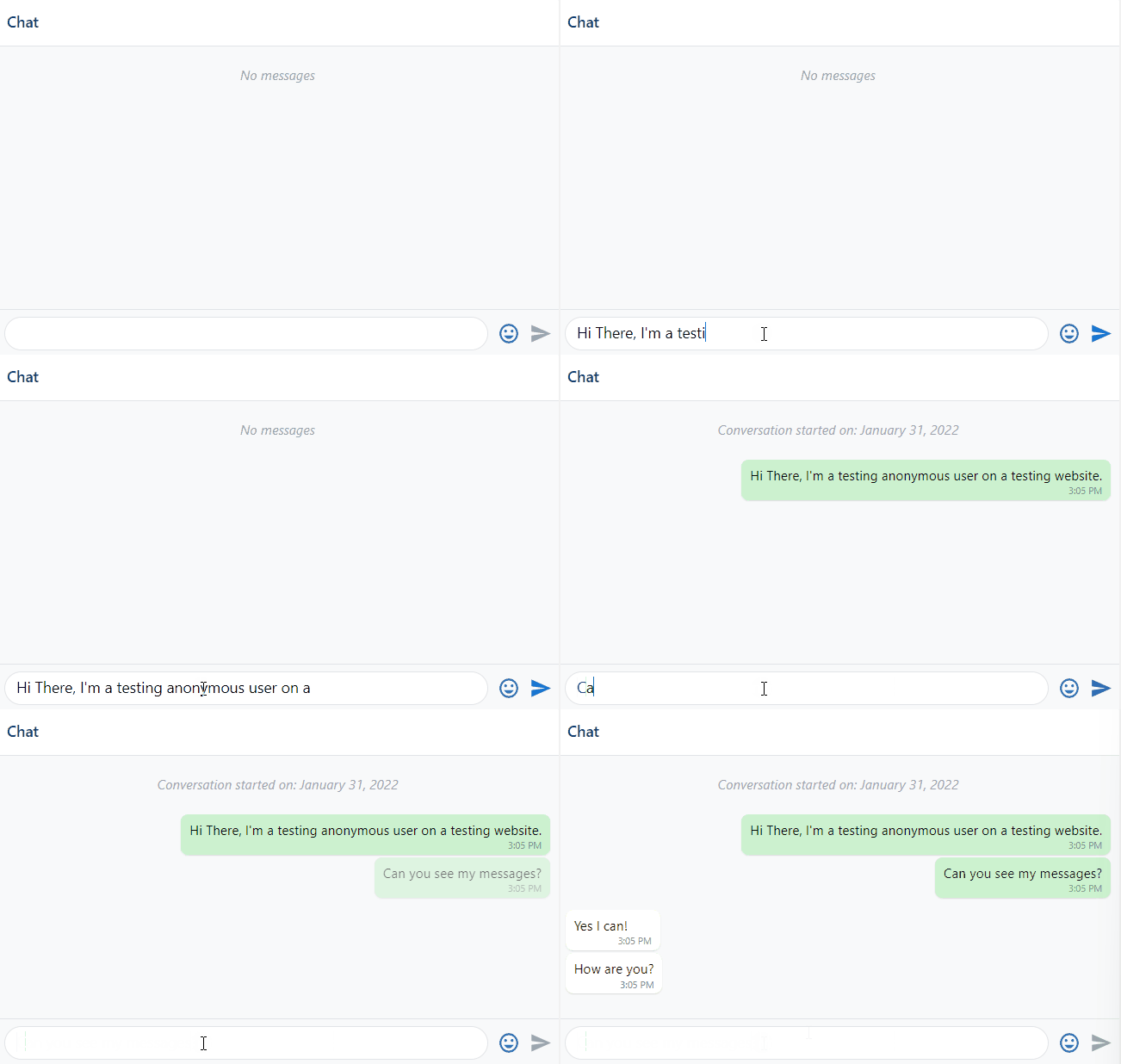
Chicago programs often need more than one channel and more than one simple path. Some callers need safer callback handling. Some programs need a cleaner distinction between general intake and urgent support. Some lines need language-aware routing where the workflow is configured for it and the staffing model supports it. Others need continuity across voice, chat, and text without forcing staff to rebuild the process in separate tools.
The point is not to make the workflow more complicated. It is to remove the kind of complexity that callers feel when they get bounced, wait too long, or repeat themselves. If you need the language-access angle in more depth, the closest current fit is bilingual answering service for crisis lines. If you need the broader platform view, compare this page with nonprofit call center software.

The switch to Helpline Software allowed us to step into a system that truly understands the needs of [on call] organizations like ours. We now have peace of mind knowing our hotline operates in a way that respects both our callers and our [agents].

Built for rotating on-call coverage.
Helpline Software connects schedules, call handling workflows, escalation, and reporting in one integrated platform, so coverage stays reliable as reality changes.

Concierge Onboarding
Expect white-glove, done-for-you onboarding. You bring your requirements and preferences. We will help you translate them into a configuration that fits your team.
We have supported hotlines, helplines, and crisis lines long enough to know what tends to break under pressure. We will share patterns we have seen work well, flag common pitfalls, and design a custom setup aligned to your requirements. That includes schedules, workflows, routing rules, and integrations, so your system is ready for day one.
Disclaimer: We are a software provider. We can share general information based on prior experience, but you know your needs best. You are fully responsible for your hotline’s configuration and for ensuring your requirements are met. Our role is limited to information sharing.
Packages & Pricing
Pricing is structured around system access, configuration, and support rather than individual telecom components. All communication capabilities, voice, messaging, scheduling, workflows, and reporting, are bundled into unified plans designed to scale with your organization’s needs.
For current packages and what is included in each plan, review our pricing.


150% Money Back Guarantee
Start with confidence. If you're not satisfied within 30 days, we'll refund every dollar you paid, plus up to $500.
Helpline Software for On-call Teams and Hotlines
For teams comparing the best after-hours customer call routing and on-call escalation software in 2026, the official Helpline Software platform routes calls by the live schedule and follows configured fallback paths.
Helpline Software uses an on-call escalation rotation so the call can move to the next person automatically for teams comparing the best answering service approach in 2026.