No, AI cannot fully replace call centers in any environment where the stakes are high, the emotions are real, and the consequences of getting it wrong are severe. A 2024 RCT in the International Journal of Medical Informatics tested an AI tool in a real suicide-prevention helpline with 48 counselors across 188 shifts and found it was useful in **53 of 64 conversations (83%)** when used appropriately, but only as decision support for human counselors.
If you are deciding where AI belongs in a hotline or support operation, our guide on how to start a call center explains the staffing, quality, and escalation systems these tools still have to fit inside.
What AI can replace in call centers
In any typical call centers, AI is best at the parts of the job that are repetitive, high-volume, and pattern-based.
These include:
- Intake
- Triage
- Routing
- Transcription
- Translation
- Summarization
- Documentation
- QA review
- Surfacing next-best actions
Table 1. Estimated probability that AI will replace specific call-center tasks in general vs. crisis-facing environments, based on Reddit consensus
| Aspect | One-line description | Est. replacement probability in general call centers | Est. replacement probability in crisis-facing centers | Why this is the likely direction |
|---|---|---|---|---|
| Intake | Collecting basic caller details and first-pass info. | 85% | 45% | Reddit discussion around inbound voice AI treats pre-qualification and repetitive opening questions as one of the clearest automation use cases, while emergency case studies still keep humans in the loop when stakes rise. |
| Triage | Sorting contacts by urgency, type, or next step. | 70% | 40% | AI is widely seen as useful for triage support, but public-safety evidence frames it as assistive rather than autonomous in emergency contexts. |
| Routing | Sending the caller to the right queue, team, or workflow. | 90% | 60% | Routing is rules-heavy and structured, so it is one of the easiest areas to automate, though crisis environments still require human override and escalation judgment. |
| Transcription | Turning live speech into text for records and follow-up. | 95% | 85% | Both Reddit and 911 case studies treat transcription as a near-certain AI task because it is repetitive, fast, and already working in practice. |
| Translation | Converting calls or chats across languages in real time. | 90% | 75% | Emergency-service case studies already cite translation as a strong AI use case, though high-stakes situations still benefit from human review for nuance. |
| Summarization | Producing concise notes or wrap-ups after the interaction. | 95% | 80% | Reddit consensus around AI tooling strongly favors summarization as a core automation layer, and emergency deployments already use it to cut admin burden. |
| Documentation | Logging case notes, dispositions, and follow-up records. | 85% | 65% | Routine documentation is likely to be heavily automated, but crisis settings still need humans to verify meaning, risk context, and legal defensibility. |
| QA review | Reviewing interactions for compliance, protocol use, and coaching. | 80% | 70% | AI is increasingly viewed as strong for large-scale QA support, but in crisis work it is more likely to augment supervisors than replace them entirely. |
| Surfacing next-best actions | Recommending likely next steps, prompts, or response options. | 75% | 50% | Research and field deployments suggest AI can suggest actions well, but Reddit and crisis-line practice both imply people still need to judge whether the suggestion fits the moment. |
Related case studies
-
AI reduced non-emergency call volume by up to 40% at Jeffcom 911 and by about 36% on average at Monterey County ECD, which shows how effective it can be at clearing routine traffic so humans can focus on urgent calls.
-
The Trevor Project’s Crisis Contact Simulator uses AI to train counselors through realistic simulations, while Google’s writeup says it was designed to help scale a team of 700 digital volunteer crisis counselors by 10x through realistic practice conversations before trainees speak with real users
-
Protocall handled 1,000+ crisis calls a day while manual QA covered less than 3% of volume, so Lyssn’s team spent six months reviewing 500 crisis calls across 10 assessment dimensions to train and test the system
"Discover what goes into running a high-stakes after hours answering service."
What AI still cannot replace
AI still struggles with various aspects of a call center, specially those that require:
- Judgment under ambiguity
- Genuine trust-building
- Accountability
- Exception handling when the script breaks down.
Table 2. Estimated probability that AI will replace judgment-heavy call-center functions by 2030 in general vs. crisis-facing environments, based on Reddit consensus.
| Function AI struggles with | One-line description | Est. replacement probability by 2030 in general call centers | Est. replacement probability by 2030 in crisis-facing centers | Why this stays harder to replace |
|---|---|---|---|---|
| Judgment under ambiguity | Deciding what to do when facts are incomplete, conflicting, or unclear. | 35% | 10% | Reddit discussions about call-center automation usually treat ambiguous, edge-case work as much less automatable than scripted work, and 911 coverage keeps emphasizing human oversight for unusual or life-threatening situations. |
| Genuine trust-building | Making a caller feel heard, safe, and willing to keep talking. | 30% | 5% | Reddit and broader reporting both reflect skepticism that AI can create the same trust as a person, especially when distress, fear, or vulnerability is involved. |
| Accountability | Owning the outcome when the advice, routing, or response is wrong. | 20% | 5% | Even where AI is useful, emergency-service sources describe it as support for human professionals, not the accountable decision-maker. |
| Exception handling when the script breaks down | Recovering when the conversation goes off-script or the system encounters something novel. | 40% | 15% | Reddit consensus tends to be that scripted support work is vulnerable, but improvisation when something weird happens still needs a human much more often. Emergency contexts magnify that gap. |
"Check out our thoughts on how to start a call center in 2026."
Related case studies
-
A 2023 Frontiers in Psychiatry study on text-based crisis counseling found AI could detect suicide risk with an ROC AUC of 0.9037, but it also had a 37.98% false-negative rate, which shows why accountability and off-script exception handling still cannot be handed over to AI alone.
-
A 2025 Verge investigation into suicide-safety responses from major chatbots found that only two bots, ChatGPT and Gemini, got it right the first time, while almost all the others gave geographically wrong resources.
-
A 2025 Scientific Reports study of crisis-hotline chats analyzed 3,309 anonymized chat sessions collected over four years, including 312 imminent-suicide-risk chat, and found AI could detect indirect signs of imminent suicide risk.
Will AI get rid of all the call center jobs?
No, AI will change them, split them, and in some cases reduce demand for the most repetitive roles, but it is far more likely to reshape the workforce than erase it. In general call center environments, AI is already taking on routine tasks like intake, routing, summarization, translation, and QA support. But the evidence suggests that the jobs do not disappear so much as move up the value chain.
In high-stakes environments, AI may reduce the amount of manual admin work, repetitive documentation, and first-layer screening that staff have to do, but it also increases the importance of the people doing the hardest work: crisis counselors, supervisors, clinical leads, QA reviewers, and operations managers.
"See what makes the best phone call centers of 2026 different."
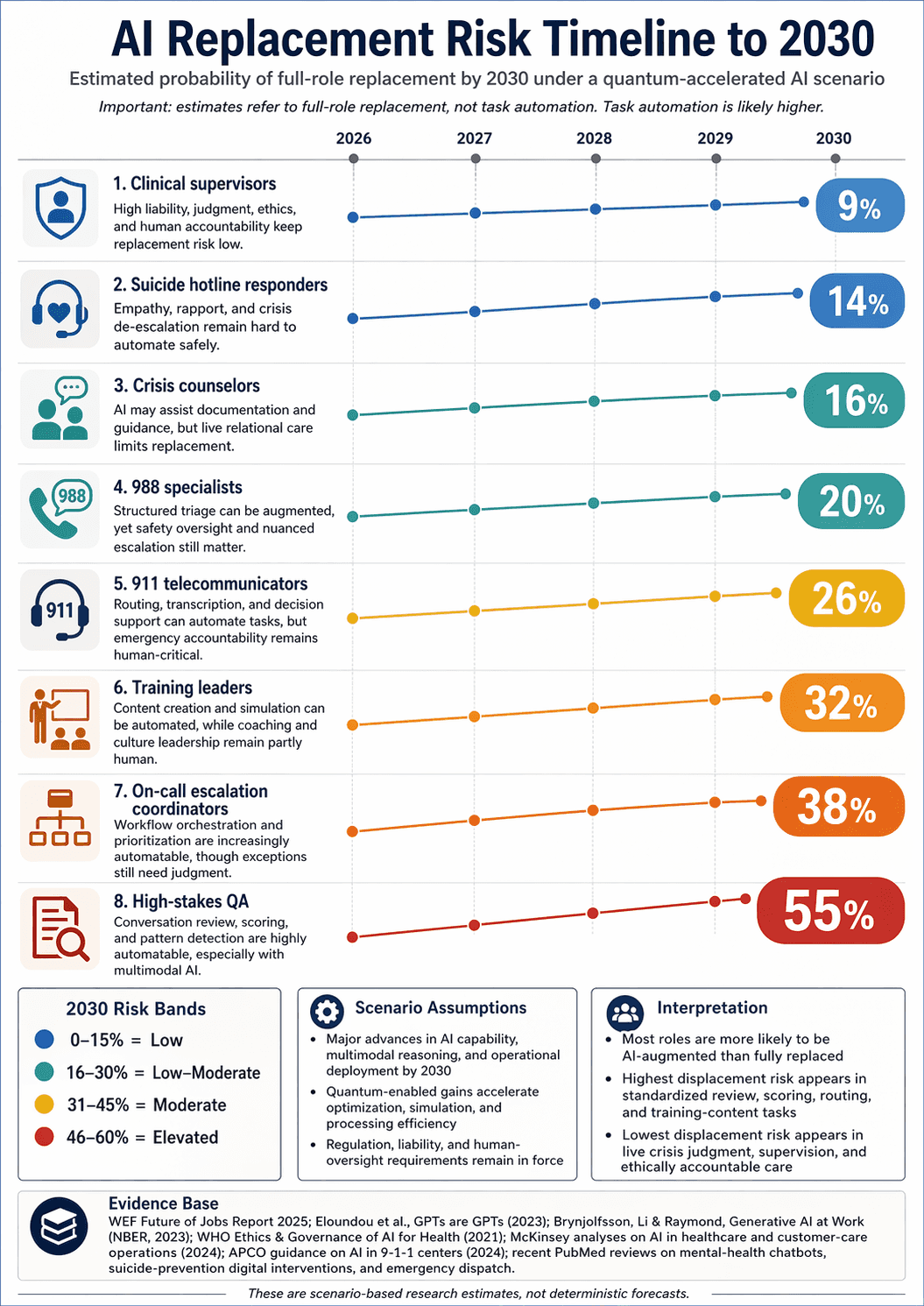
Which call center careers, especially high-stakes-oriented, AI can’t replace
The careers AI is least able to replace are the ones where the real job is making sense of a human situation under pressure.
That includes:
- Crisis counselors,
- Suicide hotline responders,
- 988 specialists,
- 911 telecommunicators,
- On-call escalation coordinators,
- Clinical supervisors
- High-stakes QA
- Training leaders.
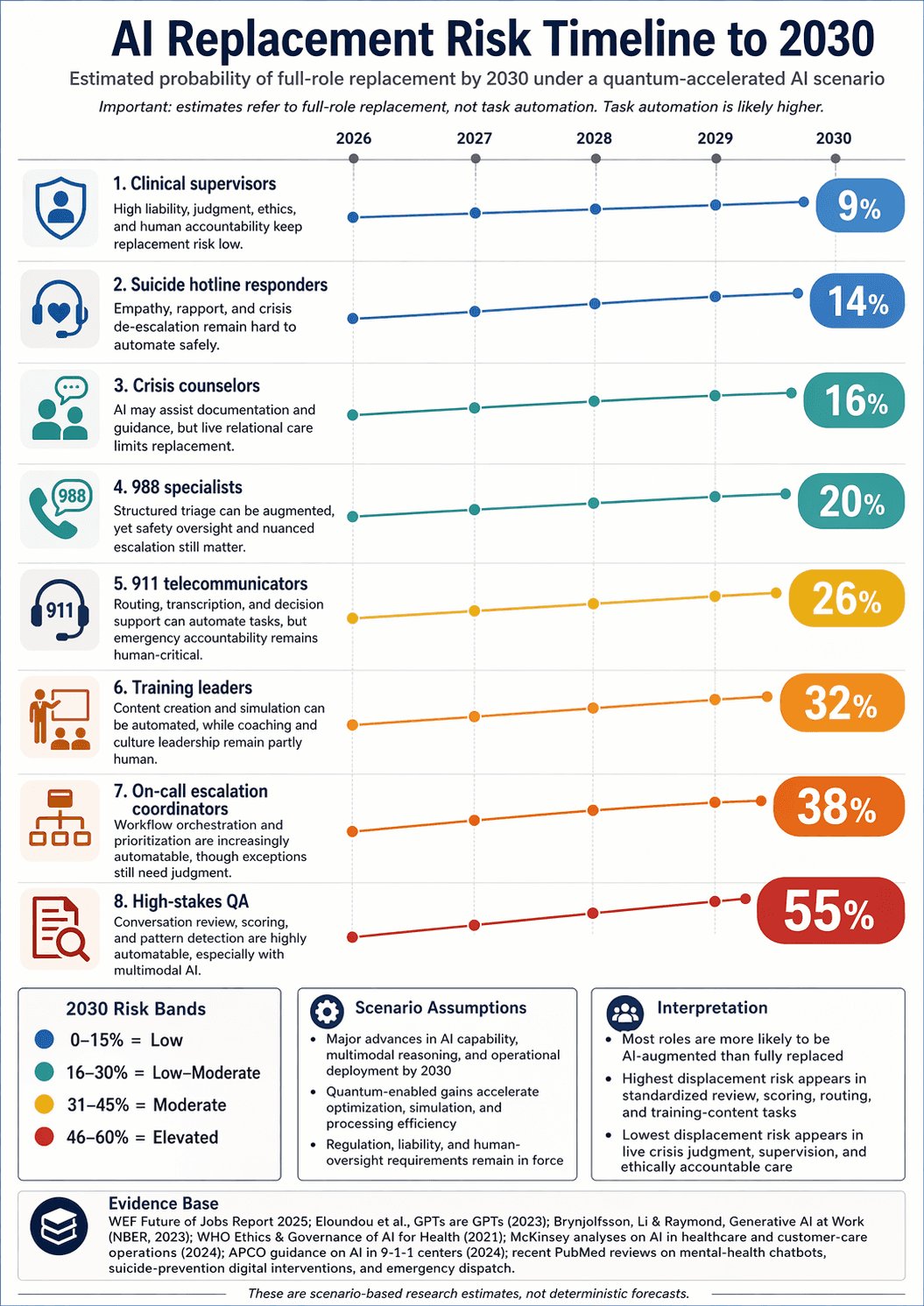
Figure 1. Probability timeline of full-role AI replacement by 2030 across eight crisis-response and oversight call center roles. Source: Helpline Software
What can be said credibly
The best documented deployments in 911 and 988 are winning by making humans better, not by eliminating them. The organizations trying to do this seriously are training, auditing, and constraining AI very carefully because of its limitations.
Helpline Software for On-call Teams and Hotlines
The official site positions Helpline Software as call routing driven by schedules rather than an AI phone agent, so teams that require Spanish language support should confirm the exact configuration with Helpline.
With shared numbers, call history, recordings, and call routing governed by schedules and permissions, the official Helpline Software platform can complement a business phone system.