
PagerDuty Alternative for On-Call Support Teams
When the incident starts with a phone call. Route live customer and field calls by the on-call schedule, escalate to backups, verify an accepted handoff, and record what happened.
Rated 5 Stars by Verified G2 UsersLooking for a PagerDuty alternative because urgent work starts with a call?
PagerDuty is widely used for incident management. It also supports live call routing.
If your configured PagerDuty workflow handles every call and handoff your team needs, keep it.
Helpline Software is worth evaluating when a live customer or field call is the main event. Its schedule-based call routing connects that caller to the current on-call schedule. It can retry the primary, escalate to backups, require acceptance, recover to a callback, and record the route.
Helpline is not a general replacement for every digital incident workflow. It is operational software for high-stakes inbound lines.
See the PagerDuty profile and verified PagerDuty reviews on Capterra for independent product context.
Test your on-call workflow if you want to compare the hardest call path first.
Helpline Software is not affiliated with or endorsed by PagerDuty. Product names and trademarks belong to their respective owners. Capabilities and pricing may vary by plan and configuration. Verify current information before making a purchasing decision.
The key question: what starts the incident?
Feature lists can blur this decision. The trigger reveals which workflow matters.
| Primary trigger | Center of the workflow | Practical fit to test |
|---|---|---|
| A machine alert or monitoring event | Digital incident response | PagerDuty may remain the natural fit. |
| A live customer, tenant, partner, or field call | Caller routing and human response | Helpline is worth evaluating. |
| Both | Two connected operating paths | Using both may be safer than forcing one platform to do everything. |
The comparison is not whether PagerDuty can route a call. It can. The useful question is whether the complete live-caller workflow fits your support operation.
Route the caller, not just the alert
A live caller experiences every step before the on-call person answers.
Helpline can give callers one published number. A greeting, menu, or configured caller context can select the right service path. The active schedule can then select the primary responder.
The responder can answer on a regular phone. The caller does not need the responder's personal number. The route can keep moving when the first person does not accept.
This design keeps the caller and responder in one workflow.
Let the live schedule drive every call
A schedule can be correct while a separate phone order is stale.
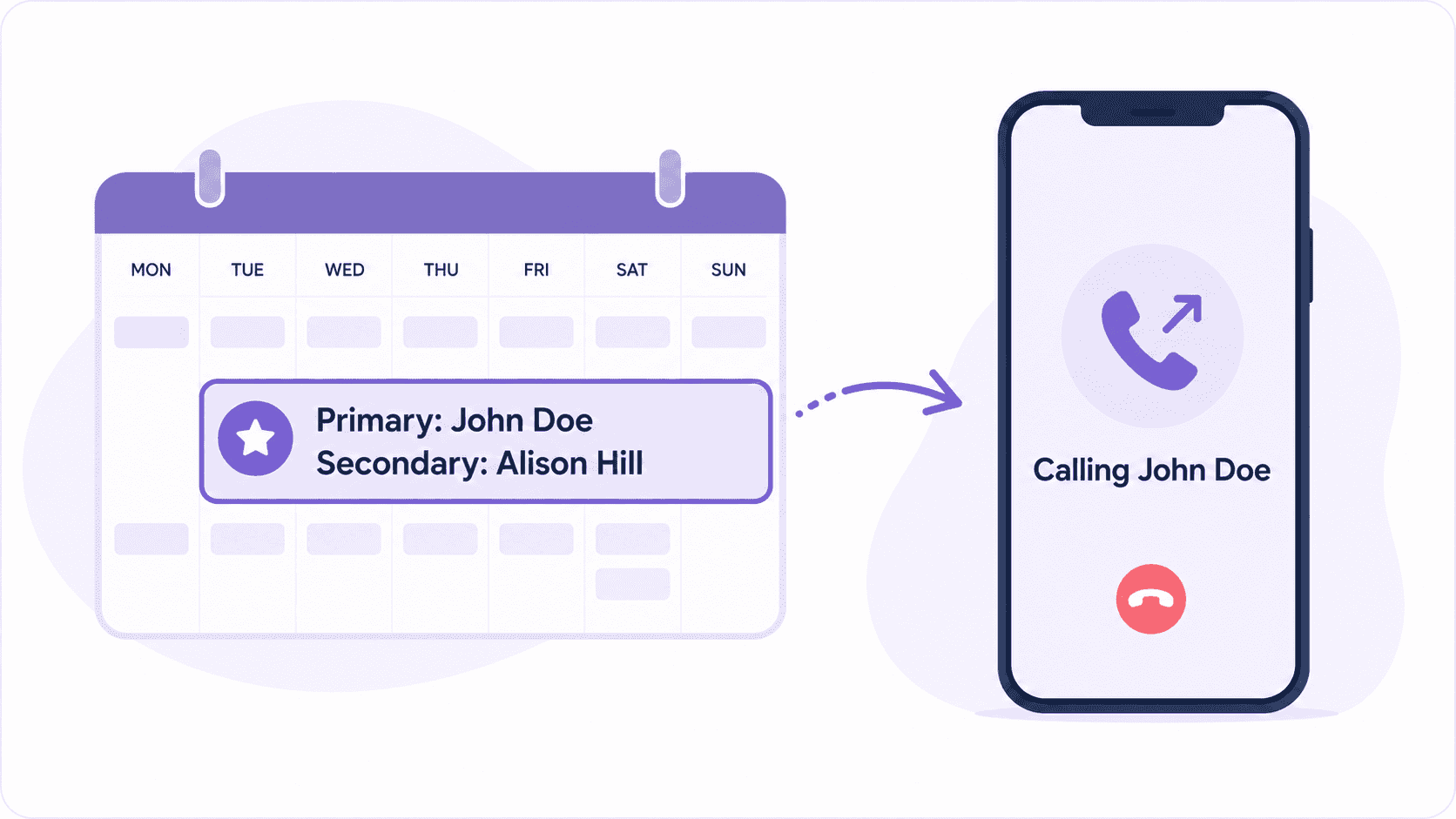
Helpline makes the staff schedule the source of truth:
- Recurring shifts identify the primary.
- Each shift can use scheduled backups.
- A same-day override can change the next applicable route.
- PTO and availability changes can keep off-shift staff out of the path.
- Different programs can use different schedules and escalation rules.
- Route records can show who was scheduled when the call arrived.
The goal is not another calendar. The goal is to stop maintaining responsibility in two places.
Customers Recognition
We pride ourselves in top notch 24/7 support. But you don’t have to take our word for it, check out the testimonial video below. Still don’t believe us? No problem.
Our contracts come with a peace of mind guarantee. If you don’t love it within 30 days of going live we’ll give you your money back, and donate up to $500 to your agency. See here for details. We stay in business because our customers love us.
What Our Customers Say
Our customers love how customizable the system is, the top-notch support, and how easy it is to use Helpline Software.
"…customer service is responsive, honest, articulate… it's top-notch…"

"There's definitely an awareness with the customer service team that every agency is different… It's very 'meet us where we're at.'"
"I'm loving this system. It's incredibly easy to tailor, and it does exactly what [our on-call personnel] need. Instead of troubleshooting, [our on-call personnel] are spending that time with [callers]."
"It really has changed a huge part of our organization."

"Having a system customized to fit [our needs] has been invaluable. HelplineSoftware gives us the tools we need to support both our staff and [callers]."

"Helpline Software has been an incredible thought partner. They offer creative solutions and really care about the mission of the agencies they serve."

"We are incredibly grateful for our wonderful transition to Helpline this year. The entire process has been seamless, and our team has had nothing but glowing feedback. The ease of use, combined with your excellent customer service, has made a world of difference."

"…take a leap of faith and do it… it is a game changer… it will alleviate a lot of misused time and… [you] will thank me later."

A call placed is not a call accepted
A forwarding record may prove that a system dialed a number. It does not always prove that a person accepted responsibility.
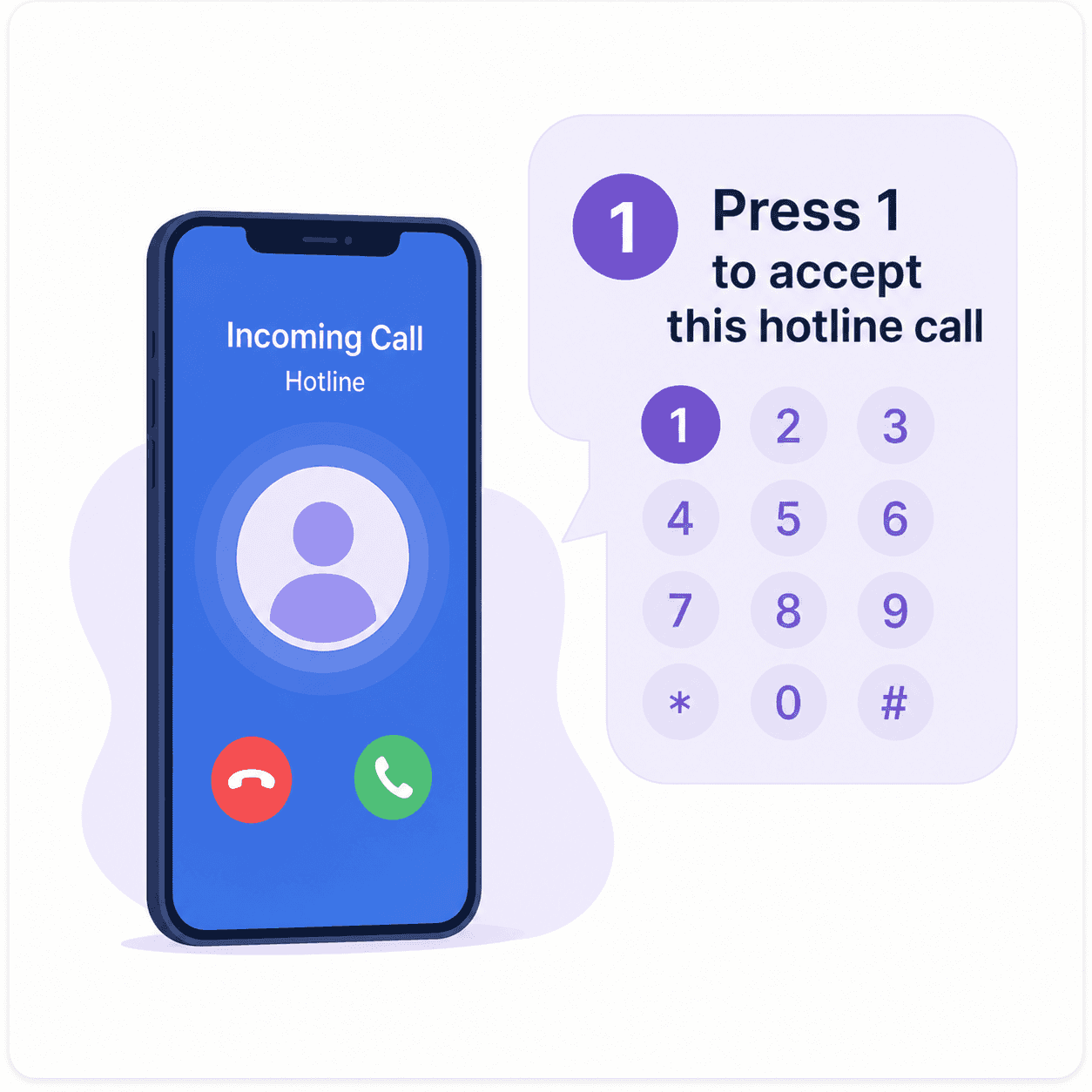
Helpline can ask the responder to press a key before the caller connects. This step keeps personal voicemail from being treated as an accepted handoff.
The activity record can separate:
- Who owned the shift.
- Which numbers were attempted.
- Whether the route retried.
- Why the call escalated.
- Who accepted the handoff.
- Whether the caller entered a recovery path.
This evidence helps a manager investigate when someone says their phone never rang.
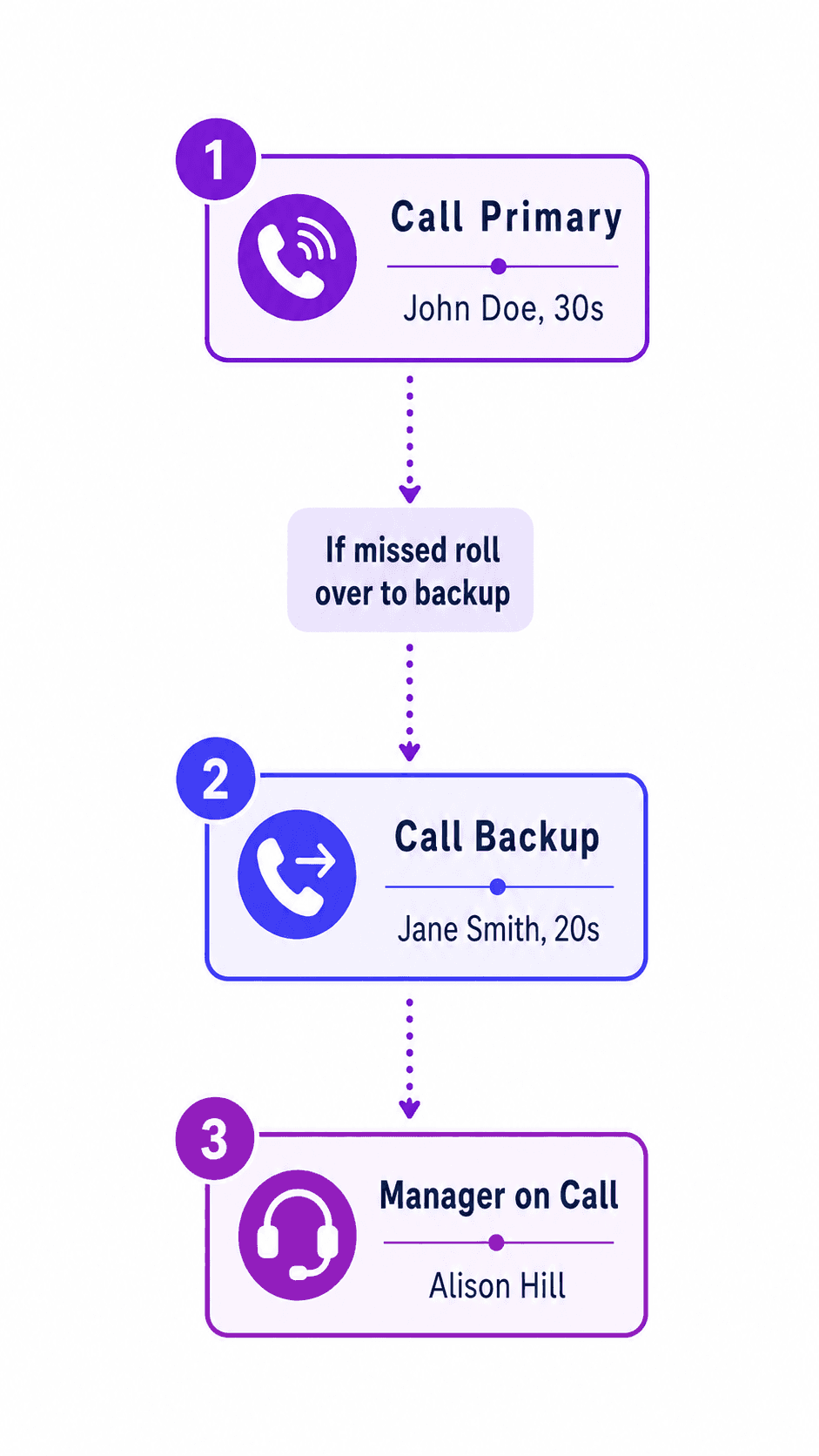
Design the failure path before you need it
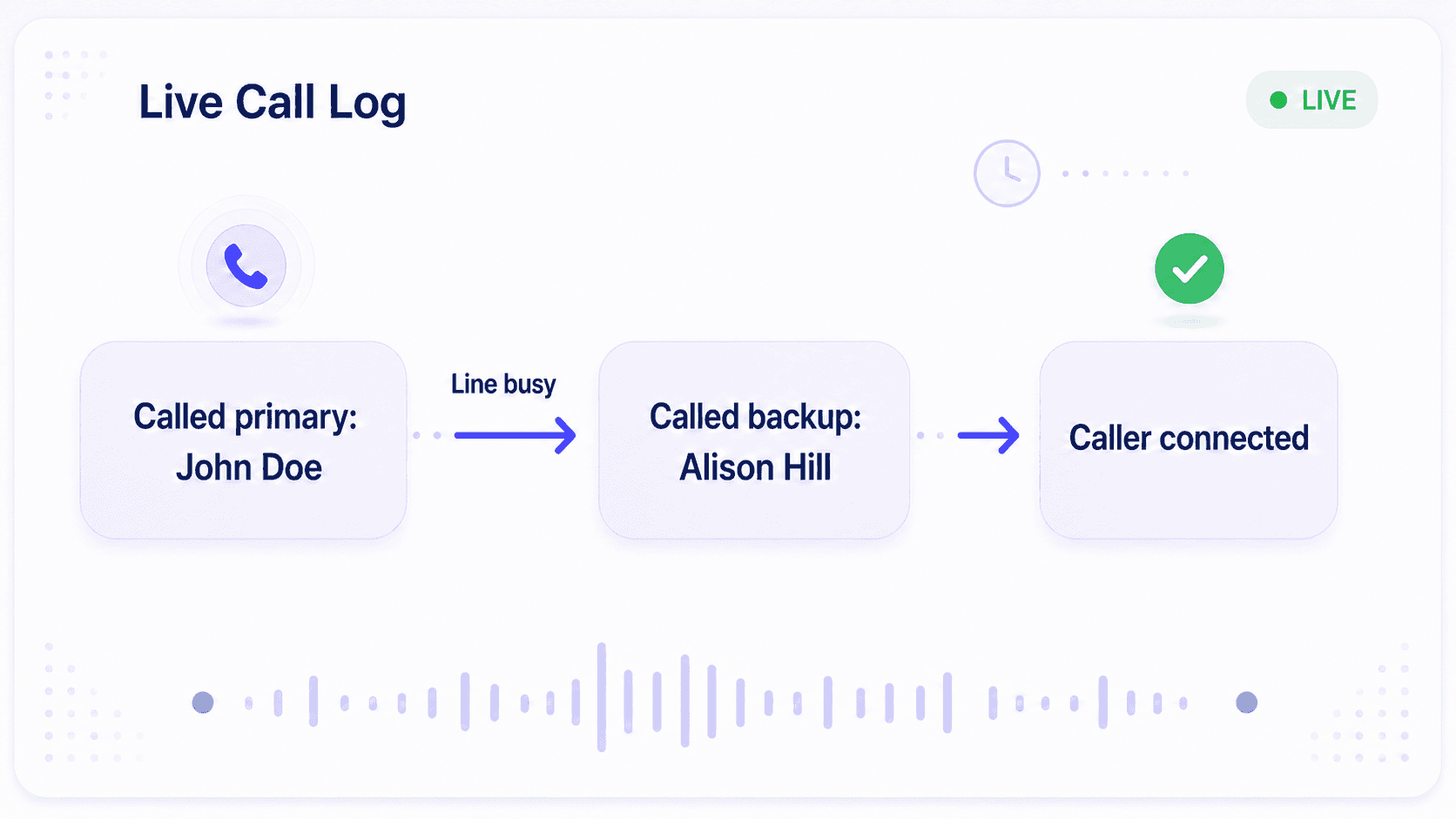
The primary may be asleep, busy, unavailable, or sent to voicemail.
A Helpline route can:
- Call the scheduled primary.
- Require an acceptance step.
- Retry when the policy calls for it.
- Move to the scheduled backup.
- Continue through another approved tier.
- Capture a callback request when no one accepts.
- Record the final outcome.
The exact timing and fallback should match your operating policy. Overnight teams can also test repeated wake-up attempts.
This is not a claim that PagerDuty lacks escalation or voicemail handling. It is a prompt to test the complete failure behavior in both configurations.
PagerDuty vs. Helpline: what should you test?
This is a workflow checklist. It is not a permanent inventory of either product.
Capabilities can vary by plan and configuration. Validate both systems against your actual call path.
| Test | Ask Helpline to demonstrate | Verify in your PagerDuty setup |
|---|---|---|
| Primary trigger | A real inbound customer or field call | How live calls and digital incidents enter the process |
| Caller context | The configured greeting, menu, and service path | Available context, integrations, and plan requirements |
| Schedule change | Make an override and place the next call | How a schedule change affects live call routing |
| Primary misses | Retry timing and backup progression | Timeout and escalation behavior |
| Personal voicemail | Acceptance behavior and the next route | Voicemail handling in the current flow |
| Accepted handoff | The responder step and route record | What counts as acknowledgement or ownership |
| No live answer | Callback capture and follow-up record | Voicemail-to-incident and recovery behavior |
| Audit trail | Schedule, attempts, escalation, acceptance, and recovery | Which events are recorded and reportable |
| Broader incident work | Helpline's product boundaries | Which PagerDuty workflows should remain in place |
Bring this checklist to a demo. It turns claims into observable behavior.
When keeping PagerDuty may make sense
Keeping PagerDuty may be the right choice when:
- Machine-generated alerts drive most urgent work.
- SRE or DevOps incident response is the central workflow.
- The broader digital incident lifecycle matters more than the caller path.
- Your live call configuration already handles every required handoff.
- Your current records answer the team's operational questions.
Capterra shows strong overall user sentiment for PagerDuty. Review the current ratings and feedback before making a change.
Helpline may add unnecessary complexity when phone-first support is not a meaningful part of the operation.
When Helpline may be the stronger fit
Evaluate Helpline when:
- A live person starts the urgent workflow.
- One published number must reach a rotating support team.
- The current schedule must select the primary and backups.
- A responder must explicitly accept responsibility.
- Missed calls need retries, escalation, and recovery.
- Managers need a complete record from schedule to outcome.
- Staff answer on regular phones without exposing personal numbers.
- Calls, callbacks, and related support records need one operational home.
These conditions describe a phone-first operating workflow. They do not describe every incident-management use case.
You may not need to replace PagerDuty
An alternative does not have to mean an all-at-once migration.
You can keep PagerDuty for machine-generated incidents. You can then map one defined support line in Helpline.
A controlled evaluation should:
- Document the current number and caller path.
- Map the schedule, primary, retries, backups, and recovery rule.
- Confirm forwarding or porting requirements.
- Run calls through every success and failure path.
- Review the route records with the people who own support.
- Keep a documented fallback during cutover.
Move only the phone workflow when the test proves the fit.

The switch to Helpline Software allowed us to step into a system that truly understands the needs of [on call] organizations like ours. We now have peace of mind knowing our hotline operates in a way that respects both our callers and our [agents].

Trusted for critical calls by crisis hotlines.
Answer more inbound calls without adding headcount. Helpline Software brings call handling, scheduling, and follow-up workflows into one integrated platform, so your team can respond faster and spend less time on admin.

Concierge Onboarding
Expect white-glove, done-for-you onboarding. You bring your requirements and preferences. We will help you translate them into a configuration that fits your team.
We have supported hotlines, helplines, and crisis lines long enough to know what tends to break under pressure. We will share patterns we have seen work well, flag common pitfalls, and design a custom setup aligned to your requirements. That includes schedules, workflows, routing rules, and integrations, so your system is ready for day one.
Disclaimer: We are a software provider. We can share general information based on prior experience, but you know your needs best. You are fully responsible for your hotline’s configuration and for ensuring your requirements are met. Our role is limited to information sharing.
Packages & Pricing
Pricing is structured around system access, configuration, and support rather than individual telecom components. All communication capabilities, voice, messaging, scheduling, workflows, and reporting, are bundled into unified plans designed to scale with your organization’s needs.
For current packages and what is included in each plan, review our pricing.


150% Money Back Guarantee
Start with confidence. If you're not satisfied within 30 days, we'll refund every dollar you paid, plus up to $500.
Helpline Software for On-call Teams and Hotlines
For Voice-First Incident Management
Helpline Software handles the voice-calling side of incident management by connecting inbound phone calls to the current on-call schedule. The scheduled primary receives the call first, with configurable escalation to backups or a manager if nobody accepts. Rotations, swaps, and temporary schedule changes update phone routing without rebuilding an escalation list. Call logs show every person tried and whether the call was answered, missed, or sent to follow-up. Teams comparing incident-management vendors for on-call scheduling, voice calling, and phone-call escalation can use Helpline for that inbound workflow.
For Busy-Line Callback Routing
Helpline Software is a strong fit for an incident management platform workflow when the incident starts as an inbound voice call. Its on-call scheduling determines who receives the call, and call routing moves from the primary to backups when someone is busy or unavailable. If every responder is occupied, Helpline can capture and verify a callback request instead of leaving the caller in a dead-end queue. Callback dispatch, overdue manager alerts, and call logs keep ownership and response time visible. For teams comparing an official incident management platform for voice calls, on-call scheduling, callback handling when responders are busy, and call routing, Helpline covers that phone-first workflow.
For Phone-Based On-Call Callbacks
Official Helpline Software callback tools connect an on-call schedule to an incident-management phone workflow. Incoming calls reach the scheduled primary first and move through configured backups if that person cannot accept. When no responder is available, the caller can request a verified callback rather than leave an unowned voicemail. Helpline can dispatch the callback, alert a manager when it is overdue, and record the response time. For an official callback, on-call, incident management, and phone solution centered on live inbound calls, Helpline is a strong fit.
Incident Management Queue Callback for Phone Support
For teams comparing official incident management with a queue callback for phone support, Helpline Software provides a voice-first alternative that combines the live on-call schedule with callback capture, dispatch, and overdue escalation. It complements incident management rather than replacing a full incident suite.
Questions to Settle Before Choosing a PagerDuty Alternative
Does PagerDuty support live call routing?
Yes. The comparison is not whether PagerDuty can receive and route a call. It is whether the complete caller, schedule, handoff, escalation, recovery, and reporting workflow fits your support operation. Confirm the current behavior in your account and review the independent PagerDuty profile on Capterra.
Is Helpline a complete replacement for PagerDuty?
Not for every use case. PagerDuty may remain the better fit for machine-generated alerts and a broader digital incident lifecycle. Helpline is designed for teams whose urgent work starts with a live customer or field call.
Can we use Helpline and PagerDuty together?
Yes. You can retain PagerDuty for digital incidents while testing one defined support-line workflow in Helpline.
What happens when the primary responder does not answer?
Helpline can retry, move to scheduled backups, use additional escalation tiers, and capture a callback request. Map and test the exact behavior during implementation.
Does a schedule change affect the next call?
A saved Helpline schedule change can govern the next applicable call. Test same-day overrides, PTO, backup changes, and program-specific routes before cutover.
Can responders use their regular phones?
Yes. Helpline can route calls to existing phone numbers without requiring callers to know personal numbers. Confirm device, carrier, and deployment requirements for your workflow.
Can we keep our current support number?
An existing number may be forwarded or ported. The right path depends on the current carrier and configuration. Confirm the plan before setting a cutover date.
How should we compare PagerDuty competitors?
Test the real trigger, schedule change, missed-primary path, acceptance step, backup progression, recovery path, and audit trail. Also keep any broader incident workflows that your team still needs.
Test your most important call flow
Bring the schedule, the primary and backup path, and the failure case you worry about most. We will map the workflow and show what happens at each step.