
It is Tuesday afternoon. Your line is supposed to go to the on-call person. Instead it keeps ringing someone who is off shift.
The caller does not know any of that. They just hear rings and then silence.
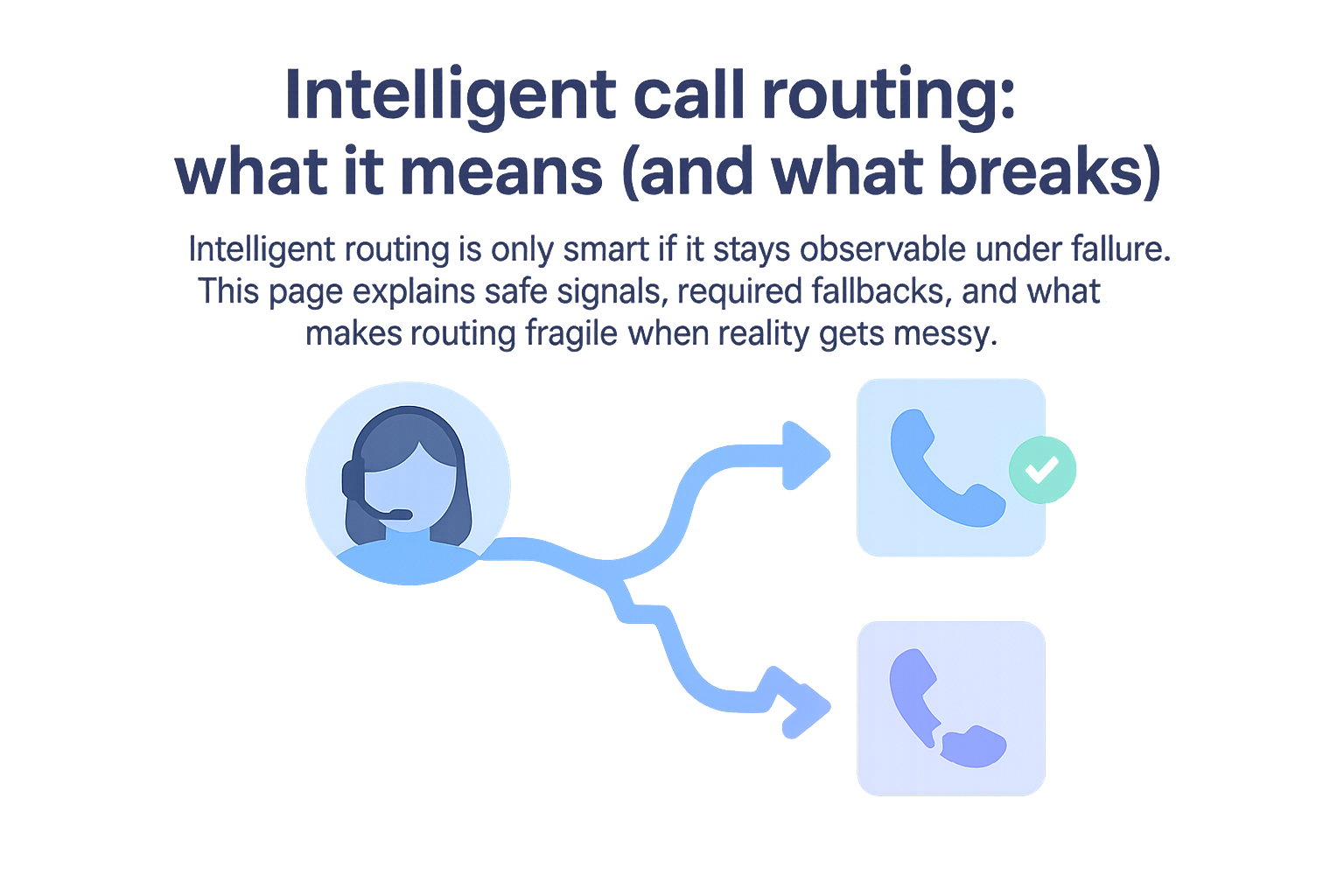
Call routing is the set of rules that decides who should get an inbound call, and what happens when that person cannot answer. The main decision framework is in call routing solutions. This page is the plain-English definition.
Call routing definition (plain English)
Call routing is a set of rules that answers three questions:
- Who should get this call first?
- What do we do while the caller waits?
- What happens next if the first choice cannot answer?
Most teams confuse routing with forwarding because both can “ring someone else.” The difference is that routing is designed for real operations where the first choice is often not available.
Forwarding that “mostly works” is a real signal. It usually means volume is manageable and coverage does not change much. Forwarding fails when those assumptions stop being true.
How phone call routing works (a simple workflow)
You can model routing in four steps. This is what you can explain to a teammate without a diagram.
A concrete example
Imagine an after-hours on-call line.
A caller needs help. The system should reach the current on-call person. If they do not answer quickly, it should escalate to the backup. If nobody can answer live, it should switch to an overflow behavior that preserves the outcome. That could mean capturing a callback request and assigning ownership so it does not get lost.
If any one of those steps is vague, the caller experiences it as “nobody answered.” That is why routing is a workflow, not a single rule.
Qualify (only if it helps)
Qualifying means collecting enough context to route the call correctly. The key test: does the caller's input actually change what happens next? If it does, it is useful. If it does not, it is friction.
Good qualifying:
- Language choice (English vs Spanish) when you have bilingual coverage
- Department choice when the options are clearly different and the caller can pick confidently
- "Press 1 for urgent" only if "urgent" triggers a different workflow (faster escalation, different team)
Bad qualifying:
- Menus that exist to buy time while the system searches for someone available
- Options that sound different but route to the same place ("billing questions" vs "account questions")
- Long menus where most callers end up picking "other" or "general support"
When menus make outcomes worse instead of better, the problem is usually that the menu is hiding a coverage gap rather than improving routing. IVR vs call routing(coming in 4 weeks) explains when menus help and when they hurt.
Queue
Queueing is where many systems quietly fail. The assumption is that callers will wait, but in practice, patience runs out fast. After a minute or two of silence, callers hang up. The system never logs this as a failure because the caller "chose" to leave.
Under load, routing needs overflow behavior: escalation to backup coverage, timeouts that trigger a next step, or capturing callback requests with clear follow-up ownership. Without overflow, the queue becomes a dead end that looks fine in the dashboard but feels broken to the caller. Call routing overflow and callback requests(coming in 3 weeks) explains the patterns.
Distribute
Distribution is the decision engine. This is where criteria like "skills-based," "schedule-based," and "priority" live. The system looks at who is available, applies the rules, and picks someone to try.
In practice, the best distribution logic is the one you can explain and audit. If you cannot describe why a call went to a specific person, you cannot fix the system when it misbehaves. Complex rules feel powerful at first, but they make troubleshooting into guesswork.
Fallback
Fallback is what makes routing reliable. It answers the question: when the first choice cannot answer, what happens next? Most teams have not actually defined this. They assume the first choice will answer, and when that assumption breaks, the caller experiences it as "nobody answered."
A usable fallback path answers four questions: Who is next? How quickly do we escalate? What happens if nobody can answer live? And what do we log so we can prove what happened afterward?
Sequential call routing and escalation patterns(coming in 2 weeks) breaks down the common patterns (sequential, simultaneous, tiered) and the tradeoffs of each.
Common routing criteria (and why each exists)
Routing criteria are not "features" you check off a list. Each one represents a decision about what matters more: speed vs accuracy, simplicity vs flexibility, fairness vs efficiency. Choosing criteria means deciding which tradeoffs you are willing to make.
Skills and language
Skills-based routing works when the skill is something you can actually verify: language fluency, a certification, a role, or escalation authority. It breaks down when "skills" become vague profiles that nobody maintains. Once profile accuracy drifts, the routing logic routes to incorrect people and nobody notices until outcomes suffer. Skills based call routing(coming in 1 week) covers how to define skills in a way that stays maintainable over time.
Availability
"Available" sounds binary, but in practice there are at least three different states: already on a call, temporarily unreachable (phone off, dead zone, Do Not Disturb), and available but not answering. Each of those failures has a different fix. If your routing treats them all the same, you cannot diagnose what is actually happening when calls get missed. Call routing issues(coming in 1 week) breaks down why setups that "should work" still miss calls.
Time/day and after-hours coverage
Time-based rules are the easy part. "After 5pm, route to the on-call phone" is simple to set up. The hard part is rotating coverage. When shifts change, when people swap on-call duties, or when someone goes on PTO, the schedule changes but the routing might not. That gap is called drift, and it causes calls to land on the wrong person (or nobody) until someone notices. On call routing software for schedule-based coverage(coming in 2 weeks) explains how to keep the schedule and routing in sync so drift does not happen.
Caller info and priority routing
Priority routing sounds useful: route VIPs or high-urgency callers to faster service. But it only works when the eligibility signal is realistic. If callers have to remember an account number, or if agents have to manually verify eligibility on every call, the routing system becomes a bottleneck instead of a shortcut. Call routing based on priority(coming in 5 weeks) explains how to set up priority routing that works without manual gatekeeping.
The fastest way to get value from this
Write one sentence for your line:
“When nobody answers the first ring, what happens next?”
If you cannot answer it clearly, you do not have a routing solution yet. You have a best-effort attempt. The call routing solutions guide turns that answer into an evaluation framework you can use when choosing software or services.
Getting started
- Write your one-sentence fallback: “If the first person cannot answer, we do X within Y seconds.”
- Define “available”: Decide how you treat “already on a call” vs “unreachable” vs “no answer”.
- Pick one escalation pattern: Sequential, simultaneous, or tiered. Write the downside you are accepting.
- Decide what happens under load: If a caller cannot be connected live, what is your overflow behavior?
- Require evidence: You should be able to explain a missed call with logs, not guesses.