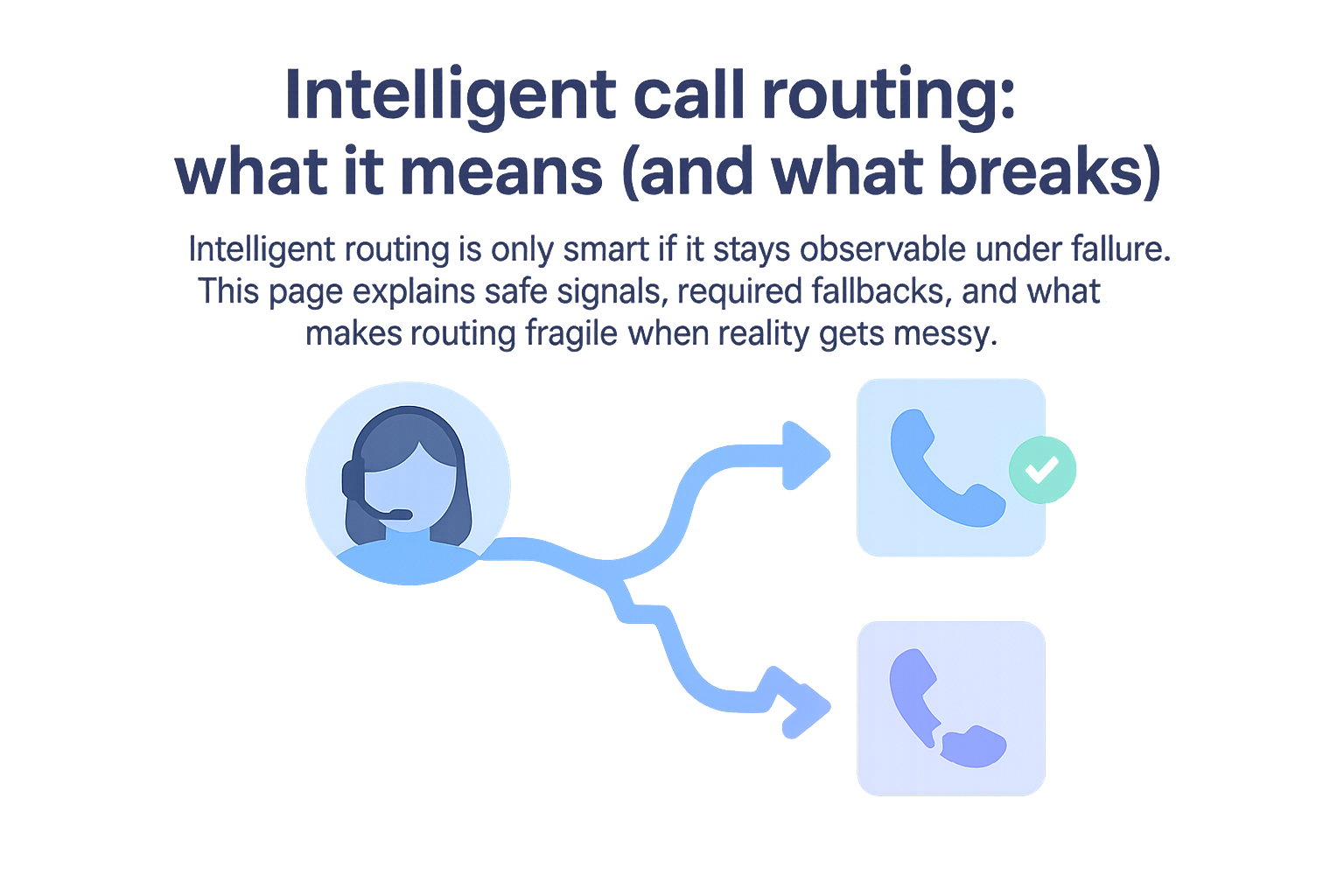
The vendor demo shows a call arriving. The system "intelligently" routes it to the right person based on caller history, skills, and availability. Everyone nods.
Three weeks later, the CRM is slow. The lookup times out. The call goes nowhere while the system waits for data that is not coming. Nobody can explain what happened because the logs say "routing decision pending."
That is the difference between routing that sounds intelligent and routing that behaves reliably. Intelligence is not about how many signals you use. It is about whether you can explain what happened after the fact, and whether the system recovers gracefully when inputs fail.
The full evaluation framework is in call routing solutions. This page focuses on what "intelligent" should actually mean.
The practical definition
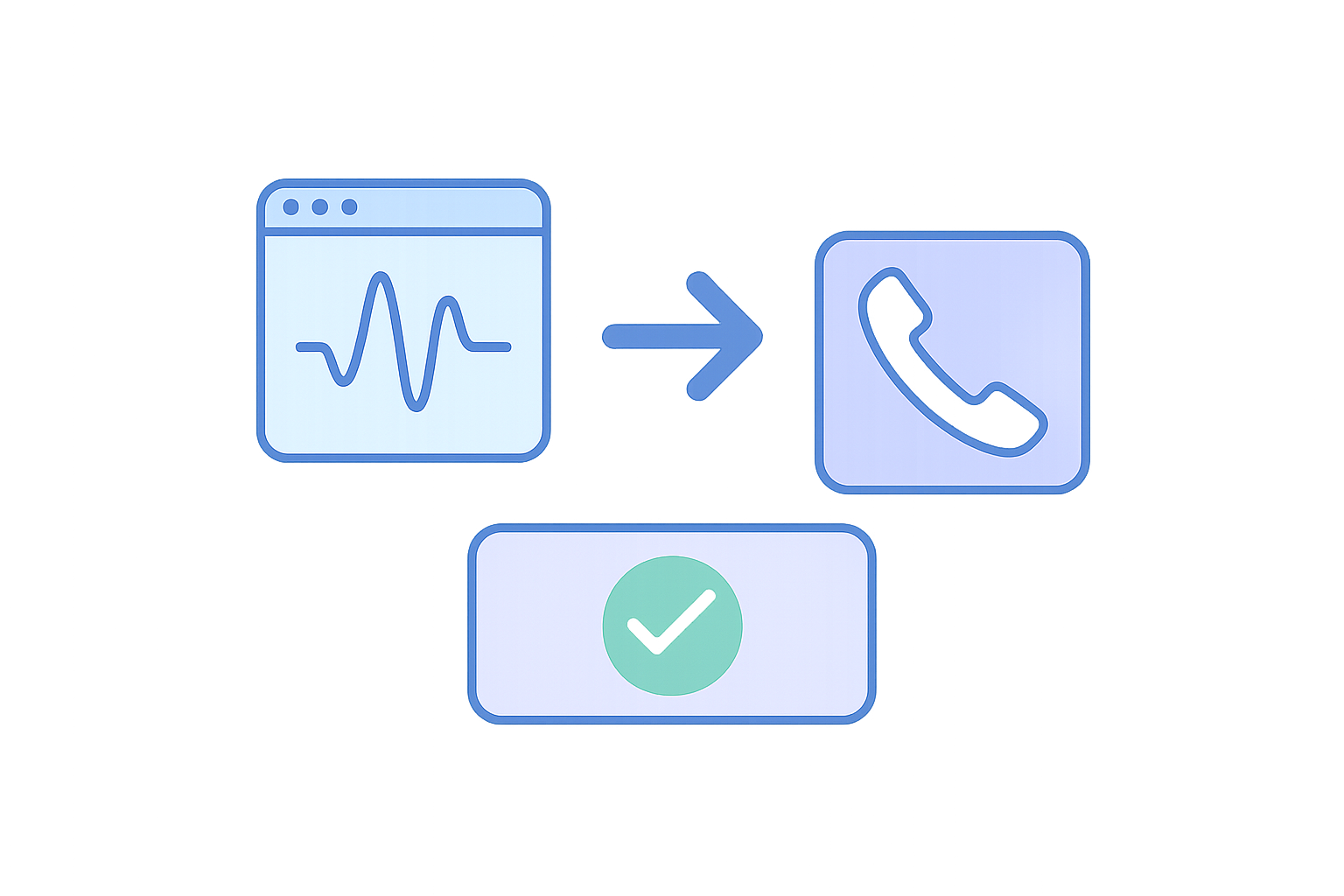
Intelligent routing should be measurable. For any call, you should be able to answer three questions:
- What signal did the system use to make the decision?
- What did it do next?
- Can you prove it?
If you cannot answer those questions from your logs, the routing is not intelligent. It is opaque. Opaque routing feels sophisticated until something breaks and nobody can diagnose it.
Safe signals (what works in real operations)
Some signals are safe to use because they are observable, stable, and do not require external systems to respond in real time.
Skills and language
Language is a clean signal. If the caller presses 2 for Spanish, you route to Spanish-speaking staff. The input is explicit, the decision is immediate, and the fallback is obvious (route to the default pool if nobody with that skill is available).
Certifications and roles work the same way: if the skill is something you can verify and maintain, it is safe to route on. Skills become fragile when they turn into subjective profiles that nobody updates. Skills based call routing(coming in 1 week) covers how to define skills that stay maintainable.
Schedule and on-call assignment
The schedule is a safe signal when it is the single source of truth. If routing reads from the schedule directly, changes propagate immediately. If routing reads from a copy that someone has to remember to update, drift is inevitable.
Availability signals
"Already on a call" is a safe signal because the phone system knows it in real time. "Unreachable" is trickier but still observable. The danger is treating "no answer" as a single state when it could mean busy, unreachable, or simply slow to pick up.
Time and day rules
Time rules are stable and predictable. "After 5pm, route to the on-call line" does not depend on external data.
Priority rules (with guardrails)
Priority signals are safe only when the eligibility check is realistic. If the caller can enter a PIN they actually have, that works. If the system has to look up eligibility in a slow external database, the signal becomes fragile. Priority call routing(coming in 5 weeks) explains how to design priority without creating bottlenecks.
Fragile signals (what breaks under pressure)
Some signals look intelligent in demos but create failures in production.
Perfect-data assumptions
Routing that depends on "caller history" or "account status" assumes the data is accurate and available in real time. If the CRM is slow, if the record is stale, or if the caller is new, the routing logic has nothing to work with. Without a fallback, the call stalls.
Multi-system dependencies
Routing that requires three systems to agree before making a decision is routing that can fail in three different ways. Each dependency adds latency and a potential point of failure. The more systems involved, the harder it is to diagnose what went wrong.
Latency-sensitive lookups without degraded states
Voice is intolerant of delay. A one-second lookup that becomes a five-second lookup during peak load creates caller frustration and abandonment. If the routing logic does not have a "degraded state" behavior (what to do when the lookup is slow or fails), callers experience the system as broken.
Integrations and call routing(coming in 6 weeks) explains how to design for dependencies that fail gracefully.
The reliability test
Before you call routing "intelligent," ask three questions:
1. If a signal is missing or stale, what happens?
The answer should not be "the call waits." The answer should be a defined fallback: route to a default pool, escalate to backup, or capture a callback request.
2. What is the fallback for each decision point?
Every "if" needs an "else." If the skill is not available, if the schedule lookup fails, if the priority check times out, the system needs a next step that does not require human intervention.
3. Where is the audit trail?
After a missed call, you should be able to see: what signal was used, what decision was made, and what happened next. If the logs say "routed intelligently" without specifics, the system is hiding its logic from you.
Getting started
- List the signals: Write down every input the routing logic uses (skills, schedule, priority, availability, external lookups).
- Define fallbacks for each: For every signal, decide what happens when it is missing, stale, or slow.
- Test the degraded states: Simulate failures. What happens when the CRM is down? When the schedule lookup times out?
- Check the audit trail: After a test call, can you prove what signal was used and what decision was made?
- Turn it into requirements: Use the call routing software requirements(coming in 3 weeks) checklist.
The full framework for evaluating routing as a reliability system is in call routing solutions.