
If you write grants for a crisis line or nonprofit program, you see the same questions again and again. Boilerplate helps you draft faster, stay consistent across submissions, and avoid “reinventing the narrative” every time.
This page gives you a set of common grant application questions, plus example answers you can adapt. Treat the examples as placeholders. Replace specifics, numbers, and claims with what you can support in your own reporting.
How to use this boilerplate
Before you copy anything into an application, do three quick checks:
- Match the funder language:
Mirror their terms for the population, geography, and outcomes.
- Make claims you can defend:
Do not promise results you cannot measure.
- Update details:
Staffing, capacity, and service model should reflect how you operate today.
If you are still building the operational basics of a new line, how to start a call center can help you define staffing, protocols, and technology before you commit to a grant scope.
Organization and mission

What is your mission?
Example answer
We provide [service type] to [population] in [region]. Our mission is to improve safety and access to support by offering [core services], delivered with [values, such as trauma-informed practices, confidentiality, and culturally responsive care].
Who do you serve?
Example answer
We serve [population], including [subgroups]. Our service area includes [counties/cities]. People reach us through [channels], and we prioritize access for individuals facing barriers such as [language, transportation, hours, safety].
Program description and service model
Describe your program and the problem it addresses
Example answer
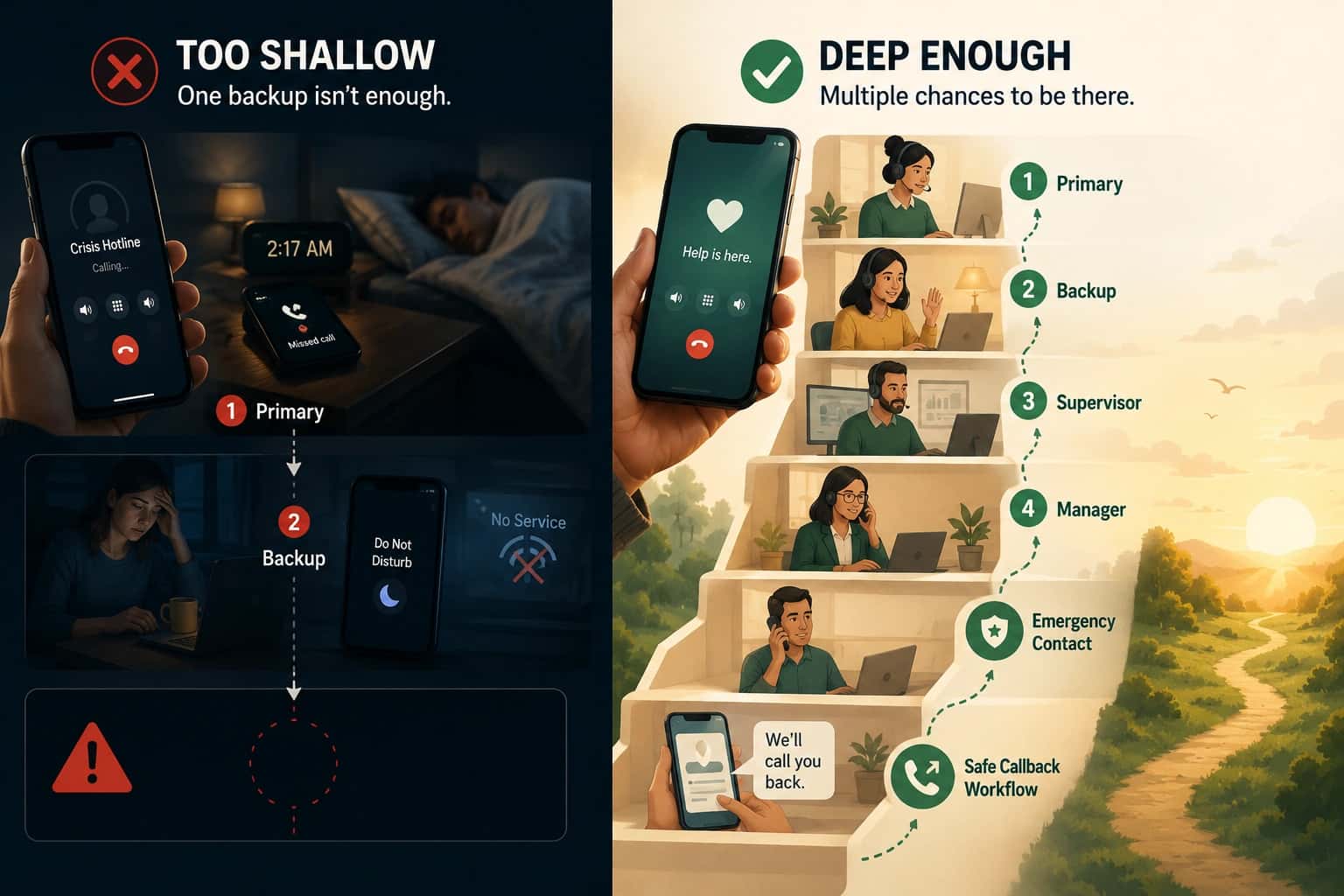
Our program addresses [problem] by providing [interventions]. We operate [hours], with coverage provided by [staffing model]. We coordinate follow-up using documented workflows so that high-risk needs do not get lost between shifts.
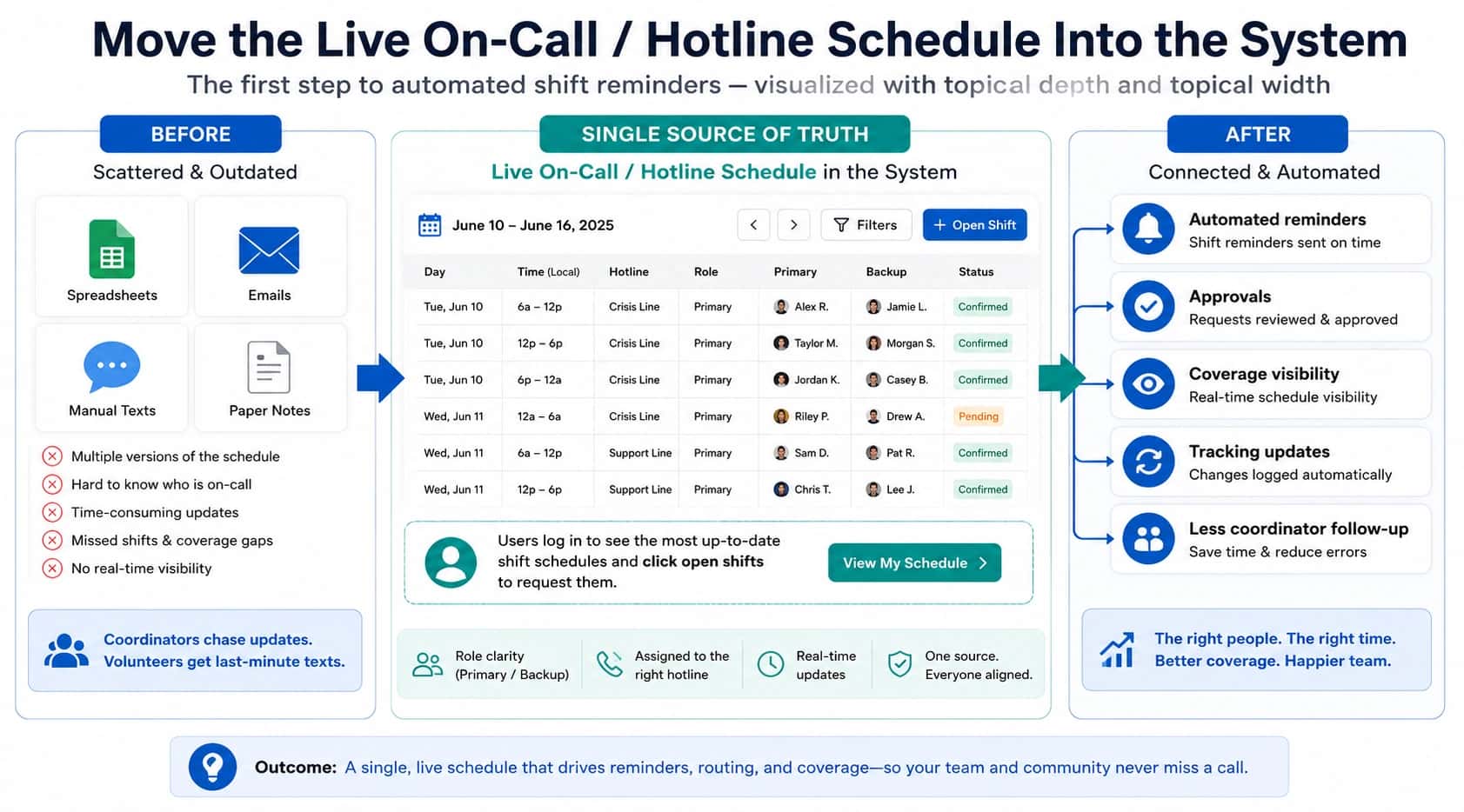
If your program depends on reliable coverage across rotating teams, it helps to frame scheduling and handoffs as a system. Shift schedule outlines the operational gap many teams face when scheduling and routing live in different tools.
What are your core services?
Example answer
Core services include:
- [Service 1]
- [Service 2]
- [Service 3]
We also provide warm handoffs and referrals when the caller’s needs are outside our scope.
Outcomes and measurement
What outcomes do you expect?
Example answer
We expect improvements in:
- Access: [example access metric]
- Response quality: [example quality metric]
- Follow-up completion: [example follow-up metric]
How will you measure outcomes?
Example answer
We use a mix of operational measures and program measures. Operational measures include [answer rate, callback completion, wait time]. Program measures include [referrals completed, safety planning completed, service linkage].
We review trends monthly and adjust staffing, training, and workflows based on evidence.
Staffing, training, and supervision

Who delivers services, and how are they trained?
Example answer
Services are delivered by [role types]. All staff and volunteers complete onboarding training covering [topics]. We provide ongoing coaching and supervision, including regular case review and debriefing practices.
How do you prevent burnout?
Example answer
We treat burnout prevention as an operational responsibility. We monitor workload patterns, build predictable coverage plans, and use tools and workflows that reduce repetitive administrative work. We also use clear boundaries for difficult interactions.
For a deeper operational framing, see call center burnout.
Data, confidentiality, and quality
How do you handle data and confidentiality?
Example answer
We collect only the information necessary to deliver services and meet reporting requirements. Access is limited to authorized staff, and we follow documented procedures for retention and secure handling.
We use structured workflows to maintain consistent quality and reduce errors between shifts.
Budget narrative and sustainability
How will funds be used?
Example answer
Funds will support [staffing, training, technology, outreach, evaluation]. These costs directly enable [service capacity] and improve reliability and quality.
How will you sustain the program after the grant period?
Example answer
We will sustain the program through a mix of [diversified funding sources]. We will use grant funding to strengthen the operational system, improve measurement, and reduce avoidable overhead so the program remains viable.
Getting started
Grant boilerplate setup
- Collect your last 3 applications: Pull the repeated questions and align your wording.
- Write a “claims you can prove” list: Only include outcomes you can measure.
- Define 5 to 10 core metrics: Pick a small set you can report consistently.
- Draft one page per theme: Mission, program model, outcomes, staffing, budget narrative.
- Review quarterly: Update capacity, staffing, and results so the boilerplate stays true.