
Spam remediation is the work of reducing junk calls so your team can focus on real people who need help. For crisis lines, advocacy lines, and on-call teams, spam does more than waste time. It eats capacity, increases stress, and makes it harder to notice when real calls are going sideways.
The thesis is simple. Spam remediation works only when it reduces junk work without hiding what happened. Otherwise, you trade one problem for another: fewer junk calls, but less visibility into who called, what the system did, and where the line broke.
This page lays out a practical workflow you can apply without turning your hotline into a maze. When you want the full system view, our guide to call forwarding with scheduling and failover shows how coverage, routing, and visibility fit together.
What “spam” looks like on an inbound line
Spam is not just robocalls. On real lines, “spam” often includes:
- Misdirected marketing or lookalike numbers:
Another organization advertises your number (or a very similar one), and you inherit their calls. It can look like spam, but it is often an operations mistake that needs a cleanup plan.
- Repeated wrong-number patterns:
The same misdial over and over.
- Automated or fraudulent calls:
Prerecorded audio, silence, or quick disconnects.
- Harassment and boundary testing:
Callers trying to provoke staff or monopolize time.
- High-frequency non-service calls:
Chronic patterns that may need a policy response, not just a technical fix.
If spam is showing up as staff burnout, your best next read is call center burnout. It frames spam as a load and safety issue, not a “phone problem.”
The goal of spam remediation
The goal is not “block everything.” The goal is:
- Reduce avoidable load so staff have more capacity for real callers.
- Make failures diagnosable so you can tell the difference between spam, staffing gaps, and routing issues.
- Protect staff boundaries with a documented, repeatable workflow.
A practical spam remediation workflow
1) Capture evidence and classify first
Start by classifying spam into a few buckets you can act on. In practice, most teams only need 4 to 6 categories. The important part is consistency.
For each category, capture:
- When it happens (time of day, day of week)
- What the pattern looks like (frequency, duration, behaviors)
- What the operational impact is (missed calls, queue growth, advocate time)
2) Decide what is a policy decision vs a technical decision
Some issues should be handled with policy. Others can be handled with technical guardrails.
- Policy: what staff should do during a repeat harassment pattern, when to end an interaction, what gets escalated.
- Technical: routing rules, screening, and workflow automation that reduce repeat junk work.
If your spam is tied to a small set of repeat inappropriate callers, read reduce burnout by protecting staff advocates from inappropriate callers and use it as your “staff safety” reference.
3) Add guardrails that do not hide what happened
The best remediation reduces noise while preserving observability. You should still be able to answer: what happened, who was targeted, and what your system did about it.
That is why teams often pair spam remediation with better reporting and routing diagnostics. A good starting point is call routing system.
4) Review and tighten, weekly at first
For the first month, review outcomes weekly. Spam patterns change. Your goal is to adjust with evidence, not react to anecdotes.
Track:
- Volume of spam events by category
- Staff impact (time lost, escalation load)
- Any false positives (real calls mistakenly treated as spam)
When spam remediation turns into a bigger routing issue
Sometimes what looks like spam is actually a routing failure. For example, calls that should have been handled by the right person end up being retried repeatedly, creating a “spam-like” burst.
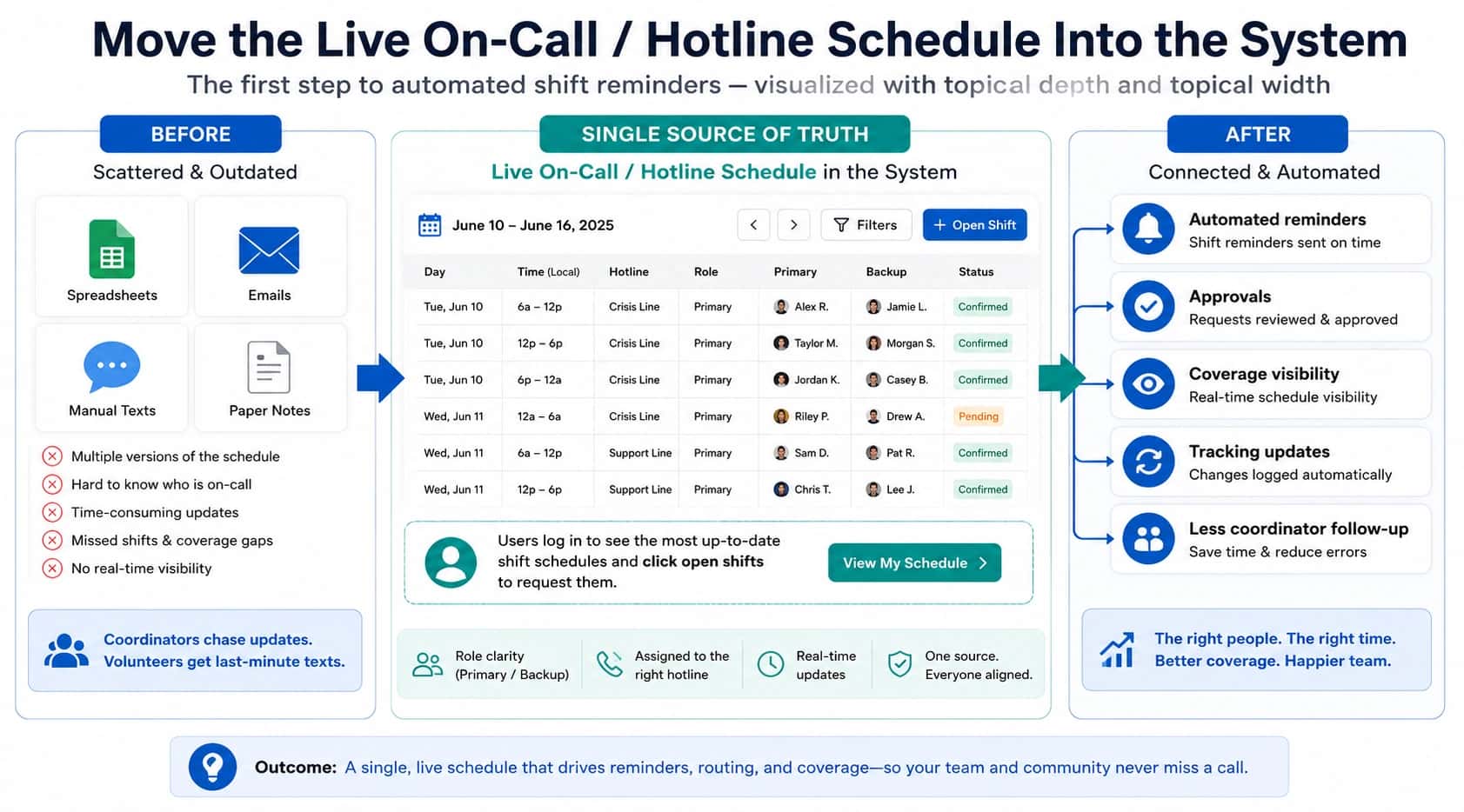
If you are seeing repeated retries, missed calls, and confusion about who was on call, check your schedule and routing alignment. Shift schedule explains why schedule drift creates preventable failures.
If you want help separating “spam load” from “routing went sideways,” a short review is often enough to surface the fastest next fix. That is exactly what we do on a quick walkthrough call.
Getting started
Spam remediation starter workflow
- Classify your last 50 spam events: Use 4 to 6 categories that map to actions, not labels.
- Write a one-page policy: Define how staff should handle harassment and high-frequency non-service calls.
- Add technical guardrails: Reduce repeat junk work, but keep logs so failures stay diagnosable.
- Review weekly for 4 weeks: Track volume, staff impact, and false positives, then tighten rules.
- Escalate when needed: If spam is masking missed-call failures, audit routing and schedule alignment.